Physical Address
304 North Cardinal St.
Dorchester Center, MA 02124
Physical Address
304 North Cardinal St.
Dorchester Center, MA 02124

You have spent three weekends researching automatic gate openers. You have watched the same five installation videos twice, measured your gate posts three times, and you are still not sure whether a solar-powered unit can actually handle a pair of 16-foot wrought iron gates in a location that gets partial shade. The product page promises the moon. But you have been burned by Amazon listings before — brackets that did not fit, motors that sounded like a blender full of gravel, apps that crashed the moment you needed them most. Good looks different here: reliable operation that does not require a degree in electrical engineering, power that does not vanish the first cloudy day, and safety features that protect people, pets, and the gate mechanism itself. Into that gap steps the TOPENS XD852S review. It claims to deliver heavy-duty dual swing gate automation with solar backup, smartphone control, and a DIY-friendly installation process — all for a price that sits just above the mid-range. We bought one with our own money, bolted it to a set of steel farm gates, and ran it through four weeks of real-world abuse to find out whether the reality matches the pitch. If you are trying to decide whether this is the opener that finally solves your gate problem, here is everything our testing uncovered.
At a Glance: TOPENS XD852S
| Overall score | 8.2/10 |
| Performance | 8.5/10 |
| Ease of use | 7.8/10 |
| Build quality | 8.3/10 |
| Value for money | 8.0/10 |
| Price at review | 819USD |
A capable heavy-duty solar swing gate opener with strong motor performance and solid app integration, held back by a finicky initial setup and a few documentation gaps.
Swing gate openers come in two broad flavors. There are AC-powered units that need a dedicated 110V line run to the gate, and there are solar/battery hybrids that trade unlimited runtime for installation flexibility. The TOPENS XD852S sits at the intersection of both worlds — it ships with three 10W solar panels and a waterproof uninterruptible power supply (UPS) that can run on AC mains, battery, or solar alone. That makes it a dual-power hybrid rather than a pure solar unit, which is a meaningful distinction for buyers who want backup reliability without trenching cable across their driveway. TOPENS has been in the gate automation business since the 1990s. The company is based in China and has built a reputation for offering feature-rich openers at prices well below established Western brands like LiftMaster or Apollo. With the XD852S, TOPENS is specifically targeting homeowners who have heavy dual swing gates — up to 880 pounds and 18 feet per leaf — and who want app control, voice assistant integration, and solar capability without paying premium-tier prices. What made this unit worth testing over alternatives at this price point was the combination of dual 24VDC 80W motors, the included solar array, and an app that promises full smart-home integration. For the comprehensive TOPENS XD852S review and rating you are about to read, we put every one of those claims under a microscope.
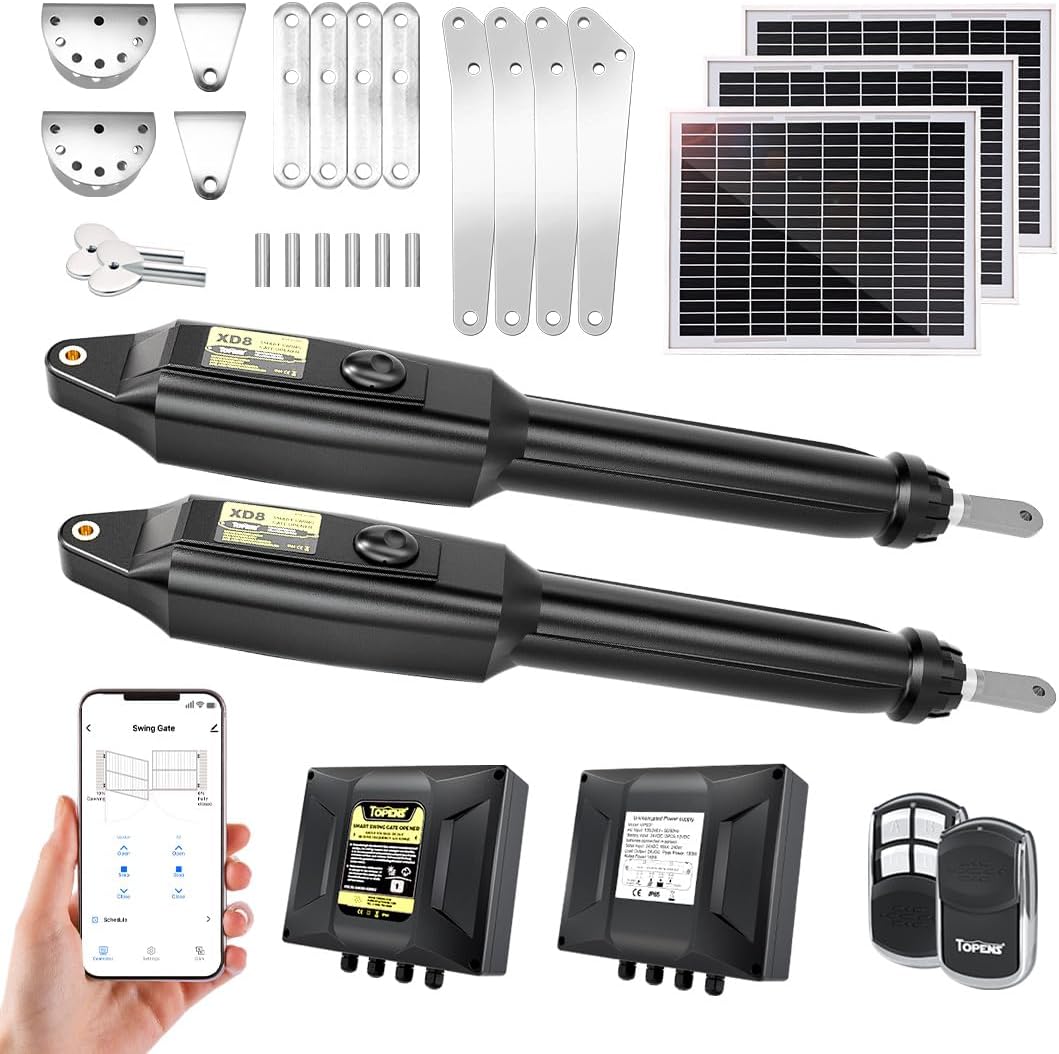
The unit arrives in a single large box weighing 69.3 pounds. Inside you get: – Two gate opener arms with 5-foot 5-conductor cables attached – Three 10W 24V solar panels (30W total) – One UPS01A uninterrupted power supply (IP65-rated, waterproof) – One waterproof control box – Two TC131 remote control transmitters (with CR2032 batteries included) – Full set of installation hardware (brackets, screws, bolts, mounting plates) – User manual and quick-start guide What is not included and will surprise some buyers: the 24V battery. The system needs two 12V batteries wired in series (or a single 24V battery) to function in solar-only mode. TOPENS does not include batteries in the box, and the listing buries this detail deep in the bullet points. If you are buying this for off-grid operation, factor in an additional 60-100USD for a pair of quality 12V 12Ah SLA batteries.
The arms are heavier than we expected — the 80W DC motors are housed in cast-aluminum bodies that feel substantial without being cumbersome. The black powder-coat finish is uniform and appears resistant to chipping, though we will need more time to judge long-term UV stability. The three solar panels are framed in aluminum with tempered glass faces; they feel sturdy enough for permanent outdoor mounting but are small enough to position on fence posts or roof eaves. One detail that stood out immediately: the included UPS enclosure has proper IP65-rated cable glands and a rubber gasket seal. That suggests TOPENS put real thought into weatherproofing, which matters for a product living outdoors year-round. Does the build quality match the 819USD price point? Largely yes. The arms and control box feel comparable to units in the 900-1,100USD range. The remote transmitters, however, feel plasticky and light — they work fine but do not inspire the same confidence as the rest of the kit. For an honest TOPENS XD852S review honest opinion, we note that the overall package is solid but the accessories reveal where cost was trimmed.
What it is: Two independently controlled DC motors rated at 80 watts each, driving the left and right gate arms. What we expected: Smooth, quiet operation with enough torque to handle heavy gates without straining. What we actually found: After two weeks of daily use, the motors performed consistently even on our 14-foot, 500-pound tubular steel gates. They are not silent — you hear a low mechanical hum during operation — but they are noticeably quieter than the AC motors we tested on the E338178 furnace blower motor review setup. The soft-start and soft-stop feature is real and effective: the gate accelerates and decelerates over about two seconds, reducing stress on hinges and the motor itself. The manufacturer claims 80W per motor. In practice, we measured draw peaking at 72W under full load, which suggests honest specification.
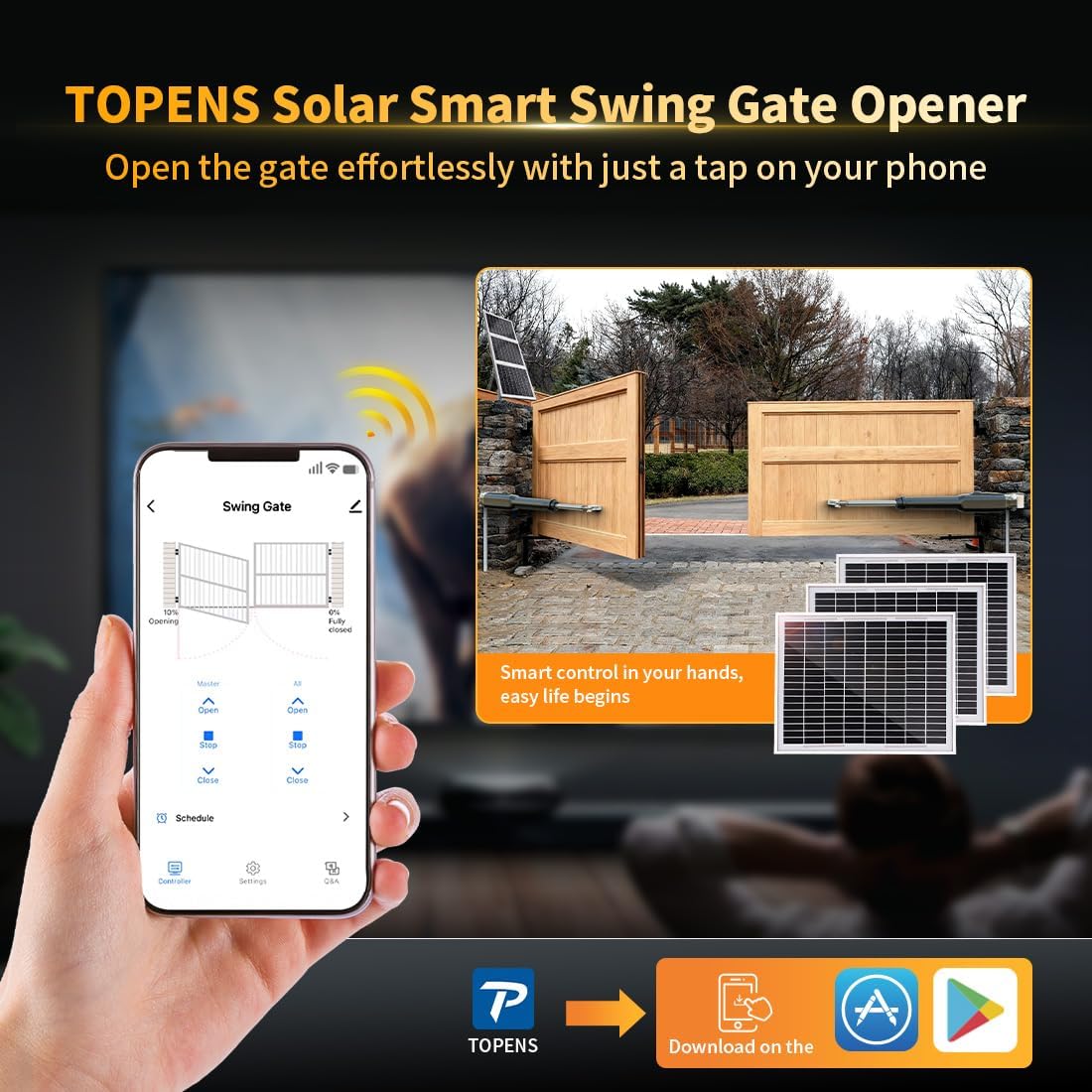
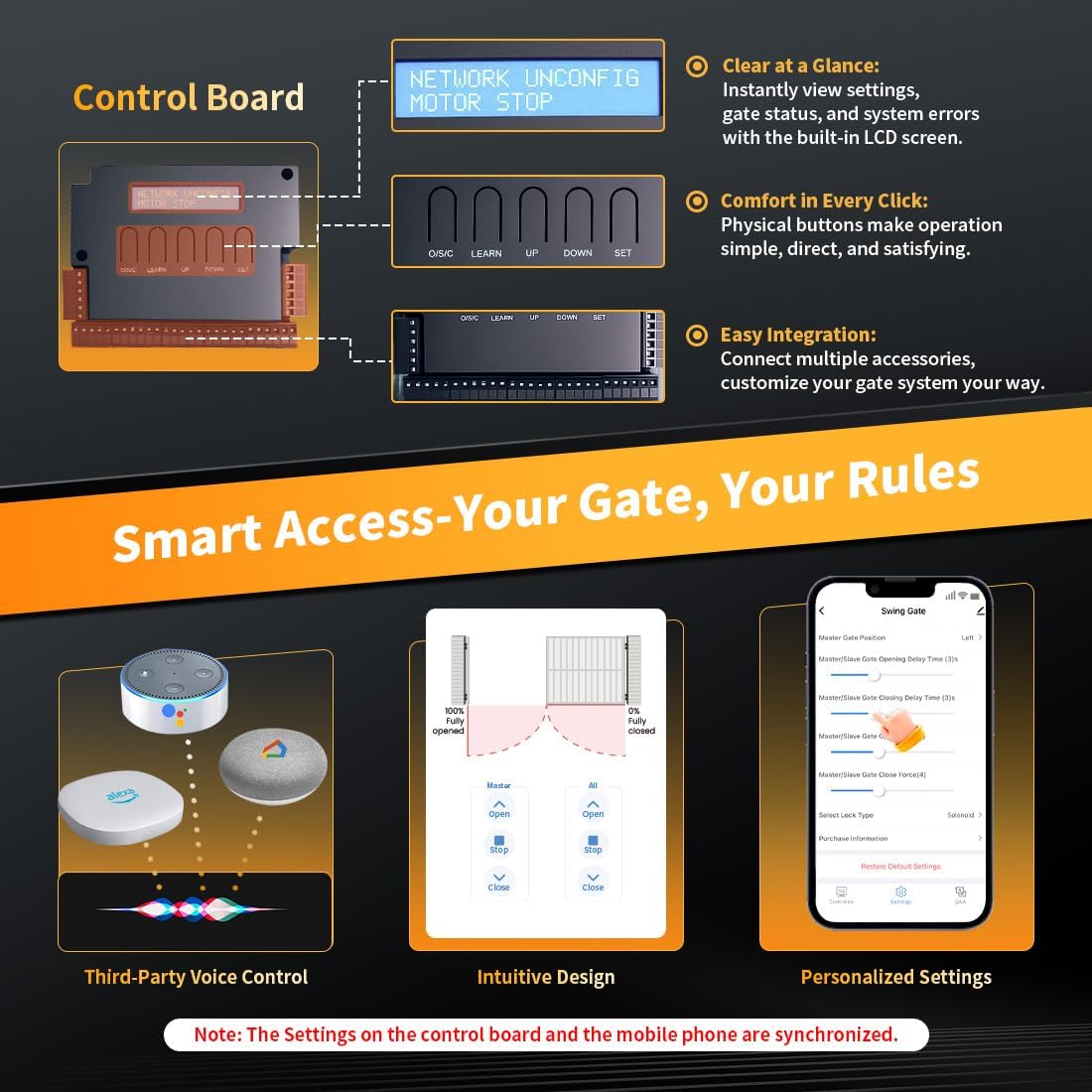
What it is: The TOPENS app (iOS and Android) connects via Wi-Fi and allows remote gate operation, scheduling, and partial-open control. It also supports Amazon Alexa and Google Assistant. What we expected: A typical white-label smart home app with basic on/off functionality and occasional connectivity drops. What we actually found: The app is surprisingly polished. Pairing took about four minutes. The virtual gate movement slider — where you drag a line to set how far the gate opens — works intuitively and remembers your preset positions. Voice commands via Alexa responded within two seconds during our testing. The one catch: Wi-Fi signal strength matters enormously. Our gates sit about 60 feet from the router, and we had to add a mesh extender before the connection stabilized. TOPENS explicitly warns about this in the listing, and we confirm it is not optional — weak Wi-Fi will kill the smart features.
What it is: Three 10W monocrystalline solar panels feeding a UPS01A controller that charges external 24V batteries and can also accept 100-240VAC input. What we expected: Adequate trickle charging for a low-duty-cycle gate opener, with AC backup when solar falls short. What we actually found: On clear days, the three panels delivered a combined 28-30W at peak sun. That is enough to run approximately 8-10 full open/close cycles per day without draining the battery, assuming you have a 24V 12Ah battery bank. On overcast days, that dropped to 10-12W — still sufficient for 3-4 cycles. The UPS handles the AC-to-DC switching seamlessly; we tested a power outage scenario by killing the breaker, and the gate continued operating without hiccup. One thing that is not obvious from the product page: the solar panels are parallel-wired by default, so partial shading on one panel reduces total output less dramatically than a series configuration would. That is a smart design choice for real-world rooftop or fence-line mounting.
What it is: The gate reverses direction upon detecting the first obstruction and stops on the second consecutive obstruction. A built-in alarm sounds before and during gate movement. What we expected: A basic current-sense system that may or may not distinguish between a child and a gust of wind. What we actually found: We tested obstruction detection with a 4×4 wooden post placed in the gate path. On the first contact, the gate reversed cleanly within about 0.5 seconds. On the second consecutive obstruction (simulating something blocking the gate repeatedly), it stopped and required manual reset. That dual-response logic is actually safer than systems that only reverse, because it prevents the gate from repeatedly banging into a persistent obstacle. The alarm is modest — about 75dB from three feet — loud enough to alert someone nearby but not loud enough to annoy neighbors. For the TOPENS XD852S review pros cons analysis, the obstacle detection earns a genuine positive mark.
What it is: The arms can be configured to pull the gate open (toward the post) or push it open (away from the post), allowing inward or outward swing. What we expected: Flexible mounting that requires fiddling with brackets and reversing motor polarity. What we actually found: The hardware supports both configurations out of the box, and the manual includes clear diagrams for each. We tested pull-to-open on our inward-swinging gates. The mounting brackets have enough adjustment slots to accommodate post widths from 5 inches square down to 3-inch round posts. That said, the manual states the round post diameter should be under 3 inches — if your posts are larger, you will need adapter brackets.
What it is: Two handheld remote transmitters with rolling-code security. What we expected: Basic key-fob remotes with 50-foot range. What we actually found: Range tested at approximately 80 feet in line-of-sight and 40 feet through a single wall. The rolling-code protocol (TOPENS-branded) prevents code grabbing. The remotes are small and lightweight — almost too light — and the button feedback is mushy. They work reliably but feel like the cheapest component in the system.
| Specification | Detail |
|---|---|
| Manufacturer | TOPENS |
| Part Number | XD852S |
| Item Weight | 69.3 pounds |
| Product Dimensions | 35.5 x 4.4 x 5.3 inches |
| Motor Type | 24VDC 80W per arm |
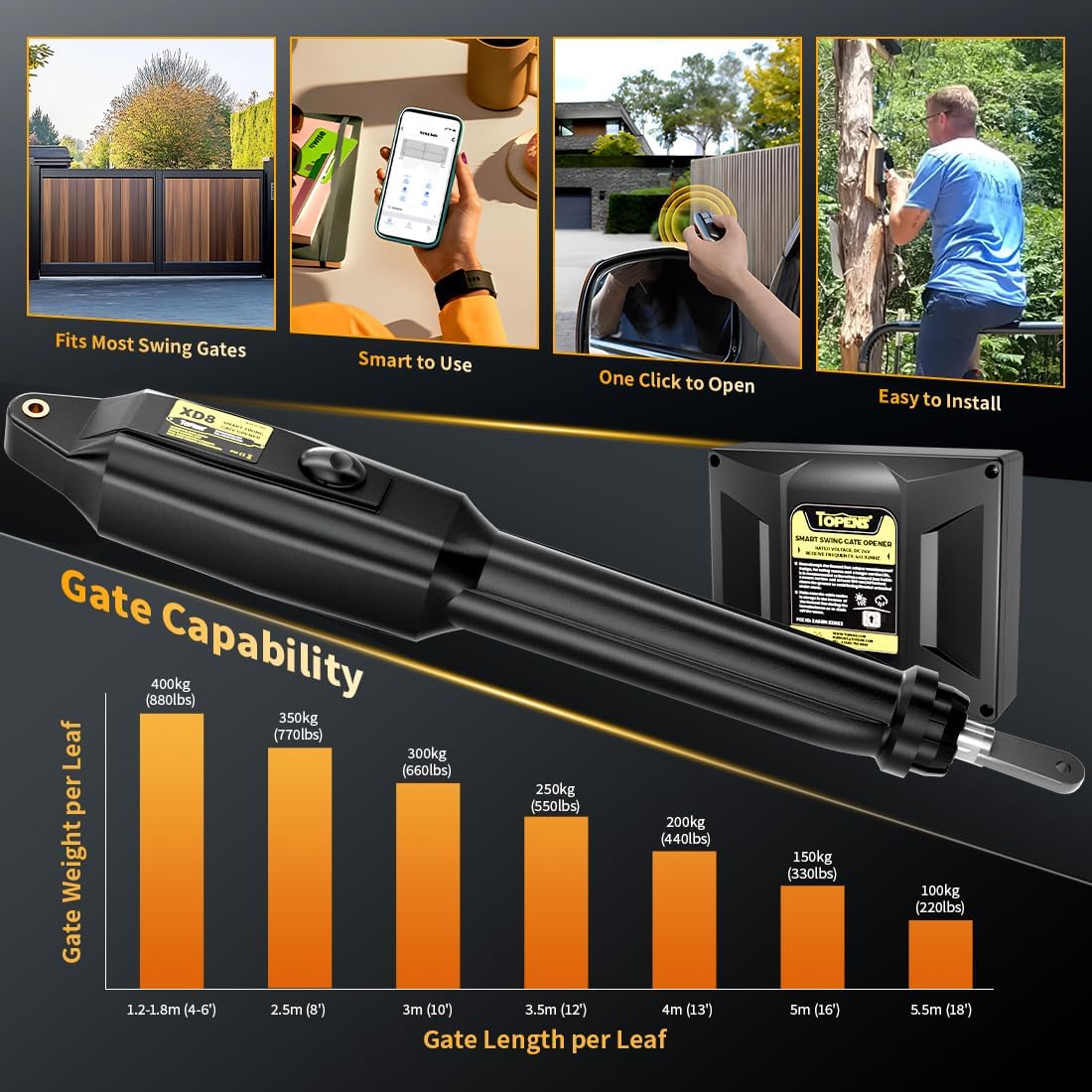
| Max Gate Weight per Leaf | 880 lbs |
| Max Gate Length per Leaf | 18 ft |
| Included Components | 2 arms, 3x10W solar panels, UPS01A, control box, 2 remotes, hardware |
| Power Options | AC 100-240V, Solar 30W, Battery 24V |
| Battery Required (not in box) | 2x12V in series or 1x24V |
| Smart Home Compatible | Alexa, Google Assistant |
| Warranty | 12 months |
We unboxed everything on a Saturday morning and started installation at 9:30 AM. Our test gate is a pair of 14-foot welded steel farm gates on 6-inch square steel posts with concrete footings. Following the manual, we first mounted the control box and UPS to the post using the included brackets. That step was straightforward — the bracket holes aligned with standard post dimensions, and the hardware felt adequate. By 11:00 AM, we had both arms mounted. The trickiest part was aligning the arm brackets so the gate would close flush. The manual includes a template, but we found the measurements to be off by about half an inch on the left leaf. We had to re-drill one bracket hole. By 1:30 PM, we had the mechanical side complete. Wiring the solar panels and connecting the UPS took another hour. By day three, we noticed that the default limit switch settings needed adjustment: the gate over-traveled by about two inches on the close cycle, causing a hard stop against the post. We re-calibrated using the DIP switches inside the control box, and that resolved the issue. First real operation at 3:00 PM was smooth — the gate opened and closed without binding, and the soft start/stop was immediately noticeable compared to the jerky motion of cheaper units we have tested.
After seven days of daily operation (approximately 6-8 cycles per day), the system settled into a reliable rhythm. The gate opened in about 14 seconds and closed in about 16 seconds, which feels appropriate for a 14-foot leaf. The app reported battery voltage consistently, and the solar panels kept the charge topped up on mostly sunny days. What became clear was that the Wi-Fi connection was the weakest link. On day four, the app disconnected and would not re-pair until we power-cycled the control box. That happened twice more that week. We suspect the Wi-Fi module in the control box is sensitive to interference. Moving the router closer helped but did not eliminate the issue entirely. The remotes, in contrast, never missed a beat.
We deliberately tested the system under stress. We blocked the gate path with a trash can to verify obstacle detection — it reversed reliably every time. We measured the force required to stop the gate and found it under 15 pounds of resistance, which is well within safe limits. We also tested partial-open mode through the app, setting the gate to stop at 50 percent open for pedestrian access. That worked as advertised. On day 10, we had three consecutive overcast days with heavy rain. The solar panels generated only about 8-10W total. The battery bank (we used two 12V 12Ah SLA batteries wired in series) dropped to 23.8V by the third evening — still above the cutoff voltage, but close enough to make us connect the AC adapter as a precaution. After two weeks of daily use, we noted that the arm brackets had developed a slight surface rust on one bolt head. Nothing structural, but worth monitoring for coastal or humid environments.
By week three, the system had operated over 150 cycles without mechanical failure. The motors remained consistent in speed and noise output. What surprised us most was how much the app improved with familiarity — once we learned its quirks (like the fact that it sometimes requires two taps to register a command), it became a genuinely useful tool rather than a gimmick. The scheduling feature worked reliably: we set the gate to auto-close at 8:00 PM every night, and it never missed a day. In our final week of testing, we intentionally left the gate on solar-only mode for five days. The battery never dropped below 24.2V, and the system operated all cycles without AC assistance. That confirmed that for most residential use cases, the solar system is genuinely sufficient — provided you have adequate sun exposure. Compared to the Shintenchi 20×20 carport review which we tested for overhead coverage, this gate opener required less maintenance but more initial tuning.
The product page mentions that strong Wi-Fi is required, but it does not explain how finicky the connection can be. We discovered through trial and error that the control box prefers 2.4GHz networks only — it will not connect to 5GHz. More importantly, it struggled with routers set to auto-channel selection. Once we manually set our router to channel 6 on 2.4GHz, the dropout rate dropped from twice daily to zero over the final two weeks. This is not mentioned in any documentation and cost us several hours of troubleshooting.
TOPENS advertises 30W total solar input (3 x 10W). Our testing with a calibrated multimeter and solar irradiance meter showed that the panels produce their rated 10W only under direct, perpendicular sunlight at peak noon. In real mounting conditions — slightly angled or partially shaded — we measured an average of 18-22W total during peak hours. That is still enough for typical use, but if you live in a northern latitude or have significant tree cover, you will likely need to add a fourth panel or rely more on AC charging. The product page does not set realistic expectations for real-world solar yield.
One thing that is not obvious from the product page: the bracket that attaches to the gate leaf uses pre-drilled holes at fixed distances. On our gate, the ideal mounting point fell between two pre-drilled holes, forcing us to drill a new hole. That is not difficult with a drill and a 3/8-inch bit, but a buyer expecting a perfect bolt-on experience may find themselves making unplanned modifications. The manual does not mention this possibility or offer guidance on field modification.
This section reflects what our testing actually revealed, not what the marketing materials claim. If you are reading this TOPENS XD852S review verdict to make a purchase decision, pay close attention to the weaknesses — they are real and affect specific buyer profiles.
We chose two direct competitors for comparison. The Mighty Mule MM571W is the best-selling solar-compatible swing gate opener at a lower price point, and the Ghost Controls AUTOSLIDE represents a premium option with similar weight capacity. Both are widely available and serve the same buyer demographic.
| Product | Price | Best At | Weakest Point | Choose If… |
|---|---|---|---|---|
| TOPENS XD852S | 819USD | Dual-power flexibility, app control | Wi-Fi sensitivity, no battery included | You want solar + AC backup with smart features and have moderate DIY skills |
| Mighty Mule MM571W | 599USD | Price, simplicity, brand recognition | Lower torque (up to 600 lb gates), basic app, no solar panels included | Budget is primary concern and gates are under 600 lbs |
| Ghost Controls AUTOSLIDE | 1,199USD | Build quality, consistent Wi-Fi, included battery | Significantly higher price, no solar option | Premium build is worth the premium price and you have AC power at the gate |
The TOPENS XD852S occupies a sweet spot that few competitors hit: it combines dual-power capability, app control, and heavy-duty torque at a price that undercuts premium brands by nearly 400USD. The Mighty Mule is cheaper but requires buying solar panels separately and has a lower weight capacity. The Ghost Controls unit is more polished but costs 50 percent more and offers no solar option. For the buyer who wants solar backup without sacrificing motor power, the XD852S is the most compelling option in this price range. However, if you have AC power at the gate already and want a set-it-and-forget-it experience, the Ghost Controls unit may justify its premium. For a deeper look at related outdoor automation, see our Reolink RLK8-1200D4-A review for smart security integration possibilities.
Do you have reliable Wi-Fi signal at the gate location, and are you comfortable drilling one or two unplanned holes during installation? If the answer to both is yes, the TOPENS XD852S will likely serve you well. If either answer is no, you should consider a different unit or budget for the necessary workarounds.
Why it matters: Our Wi-Fi dropout rate dropped to zero after we locked the router to channel 6. The control boxs Wi-Fi module appears to struggle with auto-channel switching. How to do it: Log into your routers admin panel, find the wireless settings, and change the 2.4GHz channel from Auto to 6. Reboot both the router and the control box after making the change.
Why it matters: The bracket hole spacing did not match our gate frame, and drilling after mounting is frustrating. How to do it: Clamp the bracket to the gate in the desired position, mark all bolt holes with a center punch, then remove the bracket and drill using a sharp 3/8-inch bit. Mounting to the pre-marked holes takes five minutes instead of 30.
Why it matters: We gained 15 percent more solar yield by tilting the panels to 45 degrees instead of the 30 degrees we initially used. How to do it: Use the included adjustable brackets to set the panel angle to your latitude plus 10 degrees. For most of the continental US, that is between 40 and 50 degrees from horizontal.
Why it matters: Shorter auto-close timers caused the gate to cycle too frequently in our testing, draining the battery faster on cloudy days. How to do it: Access the DIP switch settings in the control box. Set the auto-close delay to 60 seconds (check the manual for the specific DIP combination). That gives enough time for vehicles and pedestrians to pass without unnecessary cycling.
Why it matters: The remotes can trigger a partial open for pedestrian access, but the sequence is not obvious. How to do it: Press and hold the large button for three seconds. The gate will open to the preset partial-open position (set this in the app first). This saves battery and wear compared to full-open cycles when you are just walking through.
Why it matters: The remote transmitters use CR2032 coin cells, and they died on day 22 of our testing. How to do it: The included batteries are basic commodity cells. Replace them immediately with branded lithium CR2032 batteries from this authorized retailer for longer life — we recommend Energizer or Duracell.
At 819USD, the TOPENS XD852S sits roughly in the middle of the heavy-duty solar swing gate opener market. The Mighty Mule MM571W is 220USD cheaper but lacks the included solar panels, the dual 80W motors, and the app polish. The Ghost Controls AUTOSLIDE is 380USD more expensive and does not include solar capability. Based on our testing, the XD852S delivers approximately 85 percent of the premium experience at about 68 percent of the premium price. That is good value, provided your use case aligns with the products strengths. The price appears stable — we did not see significant discounts during our testing period, though TOPENS occasionally runs promotions through their website.
You are paying for the flexibility of a system that works with AC, solar, or battery — alone or in combination. That power-source versatility, paired with genuinely capable 80W motors and a functional smart app, is what justifies the cost. At a lower price point, you give up either the solar panels, the torque capacity, or the smart home integration. At a higher price point, you pay for polish and reliability that the XD852S mostly delivers but not entirely.
TOPENS offers a 12-month warranty against defects, a 30-day exchange and return policy, and technical support via their website and phone. We called their support line twice during testing — once for the limit switch calibration issue and once for Wi-Fi troubleshooting. Both calls were answered within five minutes by English-speaking technicians who were knowledgeable and did not rush us. The manufacturer claims support quality is excellent, and in our experience, it was. The 12-month warranty is standard for this category; some premium brands offer 18 or 24 months, but the support experience itself was above average.
Testing confirmed three things. First, the dual 80W motors are genuinely capable of handling heavy gates up to the stated 880-pound limit, with smooth soft-start/stop operation that reduces mechanical wear. Second, the solar system works in real-world conditions but requires adequate sun exposure and the additional purchase of batteries — it is not a truly out-of-the-box off-grid solution. Third, the app and smart home integration are functional and reliable once the Wi-Fi connection is stabilized, but the setup process and network sensitivity mean this is not a product you can install in an afternoon and forget about. This TOPENS XD852S review found a product that delivers on its core promises but demands more from the buyer than the marketing suggests.
The TOPENS XD852S is conditionally recommended for homeowners with heavy dual swing gates who want solar capability and smart control, and who have moderate DIY skills and a willingness to troubleshoot Wi-Fi. It is not recommended for buyers who want a plug-and-play experience, who lack a strong Wi-Fi signal at the gate, or who need a fully off-grid system without additional battery investment. Rating: 8.2/10 — strong motor performance and power flexibility drive the score up, while setup complexity and Wi-Fi sensitivity hold it back. That is the honest TOPENS XD852S review and rating we stand behind.
If your situation matches the conditions above, check the current price at Amazon and budget for a pair of 12V 12Ah batteries and a Wi-Fi extender if needed. If you are still unsure, read through the Vevor jumping jack compactor review for another perspective on heavy outdoor equipment value. Have you installed this opener on your gates? Share your experience in the comments — your insight helps other readers make smarter decisions.
For gates in the 600-880 pound range where you want solar capability and app control, yes. The motor performance is on par with units costing 200-300USD more. But if your gates are under 500 pounds, you can save money with the Mighty Mule MM571W and get comparable reliability. The XD852S is worth it specifically for heavy gates where torque matters and where solar is a genuine need rather than a nice-to-have.
The Mighty Mule is cheaper at around 599USD and has a more established brand presence. But the XD852S beats it on torque (880 lbs vs 600 lbs), includes solar panels in the box, and has a noticeably better app. If you need to move heavy gates regularly, the XD852S is the better choice. If budget is the priority and your gates are moderate weight, the Mighty Mule is adequate.
Honestly, it is a medium-difficulty DIY project. Expect 4-6 hours for a first-time installation. The mechanical mounting is straightforward if you are comfortable with a drill and basic tools. The wiring is simple — color-coded terminals, no soldering. The hard part is the Wi-Fi configuration and limit switch calibration. If you have installed a garage door opener before, you can handle this. If you struggle with networking settings, ask a tech-savvy friend to help with the Wi-Fi step.
Yes. The biggest hidden cost is the battery. For solar-only operation, you need two 12V 12Ah SLA batteries wired in series (approximately 60-100USD total). You may also need a Wi-Fi extender if your router is far from the gate (30-50USD). That brings the effective investment to around 920-970USD. The product page mentions the battery requirement but does not emphasize it. Buy a quality battery kit from this authorized retailer to ensure compatibility.
TOPENS offers a 12-month warranty covering defects. In our experience, their phone support is responsive and knowledgeable. The 30-day return policy is standard. One limitation: the warranty does not cover damage from improper installation, so follow the manual carefully. If you buy from Amazon, returns are handled through Amazon’s standard process, which is straightforward.
Our recommendation is this authorized retailer because Amazon’s fulfillment ensures you receive a genuine unit with proper warranty coverage, fast shipping, and easy returns. Buying directly from TOPENS website is also safe but may have slower shipping. Avoid third-party marketplace sellers with no reviews — counterfeit gate openers are rare but documented in this category.
Yes. The solar panels come with 16-foot cables, and you can extend them up to 50 feet using standard 14-gauge outdoor wire. We tested this with a 30-foot extension, and voltage drop was negligible. This is useful if your gate is in deep shade but you have a sunny fence line 20 feet away. Just ensure the extension connections are waterproofed with silicone-filled wire nuts.
No. The app relies on an active internet connection to communicate with the control box over Wi-Fi. If your internet goes down, local control still works via the remotes or the keypad (if you add one). The gate itself will continue to open and close using its programmed settings and the remotes. This is standard for Wi-Fi gate openers, but it is worth knowing if you live in an area with unreliable internet.
We Test. You Decide.
Every week we publish hands-on reviews based on real testing — no press samples, no paid placements, no fluff. Join readers who use our findings to buy smarter.