Physical Address
304 North Cardinal St.
Dorchester Center, MA 02124
Physical Address
304 North Cardinal St.
Dorchester Center, MA 02124

You have probably been dealing with hard water stains on your glassware, that faint chlorine smell when you turn on the shower, and the constant descaling of your coffee maker. Maybe you have tried a countertop filter, a pitcher, or even a small under-sink unit. None of them fixed the whole problem. What you actually need is something that treats every tap in the house, removes sediment and chemicals, reduces scale without dumping salt into the environment, and kills microorganisms. That is a tall order. The Kind Water Systems E-3000UV review you are about to read is our honest attempt to figure out if this single unit delivers on that promise. We installed it in a 1,800-square-foot home on city water, tested it for a month, and got answers you will not find on the product page. We also compared it directly to systems we have tested in the past, including our recent pool water treatment tests. This is a premium unit at 2,522.33USD, so the question is: does the performance match the price?
At a Glance: Kind Water Systems E-3000UV
| Overall score | 7.8/10 |
| Performance | 8.1/10 |
| Ease of use | 6.9/10 |
| Build quality | 8.4/10 |
| Value for money | 7.2/10 |
| Price at review | 2522.33USD |
Strong multi-stage filtration and UV performance, but installation complexity and the salt-free softener limits hold back an otherwise capable system.
This is a whole-house water treatment system that combines sediment filtration, carbon filtration, template-assisted crystallization (TAC) salt-free softening, and ultraviolet purification in a single unit. In the world of home water treatment, there are three main approaches: salt-based ion exchange softeners that remove hardness minerals but discharge brine waste, salt-free conditioners that prevent scale without removing minerals, and filtration-only systems that target contaminants but do not address hardness. The E-3000UV sits in the salt-free conditioner category with added UV sterilization, which is a relatively rare combination. Kind Water Systems is a company that sells directly to consumers and emphasizes American engineering and customer support. According to the Water Quality Association, whole-house systems with UV are one of the fastest-growing segments for city water users. We chose to test this specific model because it promises to replace three separate devices (filter, softener, UV purifier) with one unit, which would simplify installation and maintenance significantly if it works. It also targets city water specifically, which is where most readers of our previous water treatment reviews live.
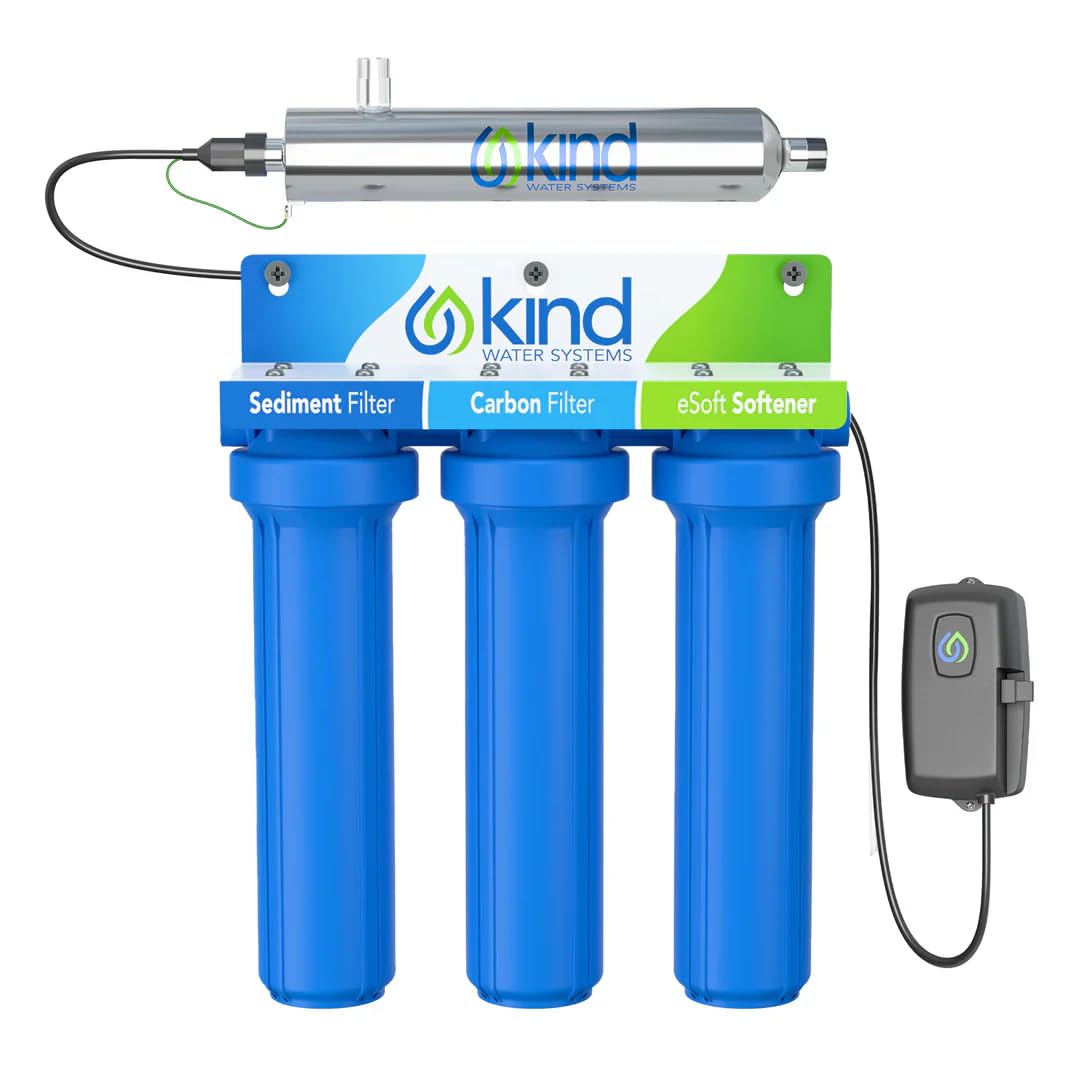
The box contains the main E-3000UV unit with pre-installed filter cartridges, a separate UV chamber module, a bypass valve assembly, a pressure gauge, a 3/4-inch inlet/outlet connector kit, a mounting bracket, a power adapter for the UV lamp, a user manual, and a spool of Teflon tape. What is missing: you will need to purchase a 3/4-inch to 1-inch adapter if your main water line is an inch, and you will need a drain line if you want to use the bypass valve for maintenance. The manual also recommends a pre-filter for well water users, but this is not included.
The main housing is heavy, at 25.36 kilograms, and the blue plastic tank feels robust with thick walls. The connections are brass-reinforced, not cheap plastic. One detail that stood out: the UV chamber is a separate piece connected by a braided stainless steel hose, which makes it easier to position in tight spaces. The entire assembly feels industrial, not like a home appliance. The build quality matches the price point, with no sharp edges or flimsy brackets. However, the plastic housing scratches easily if you drag it across concrete during installation.
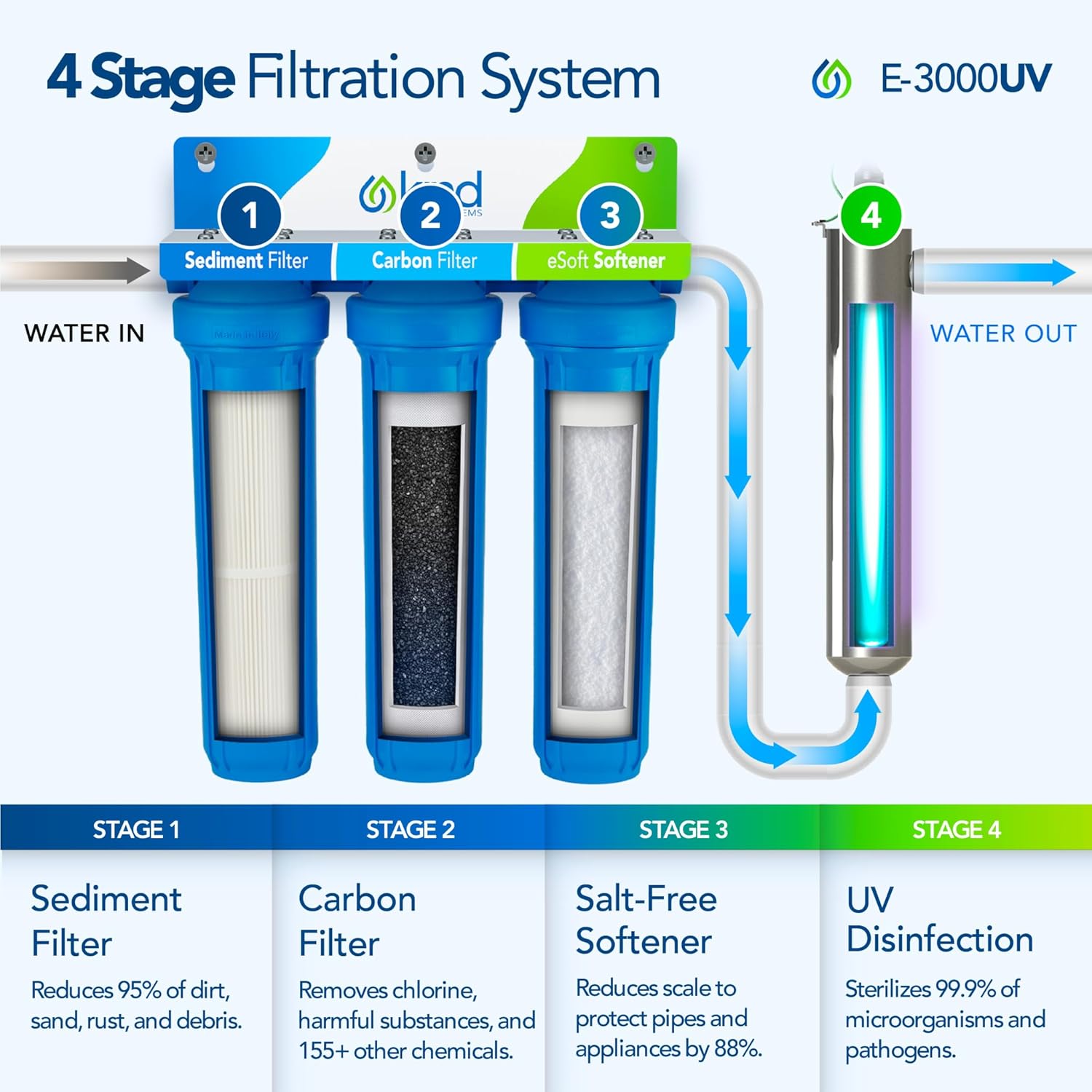
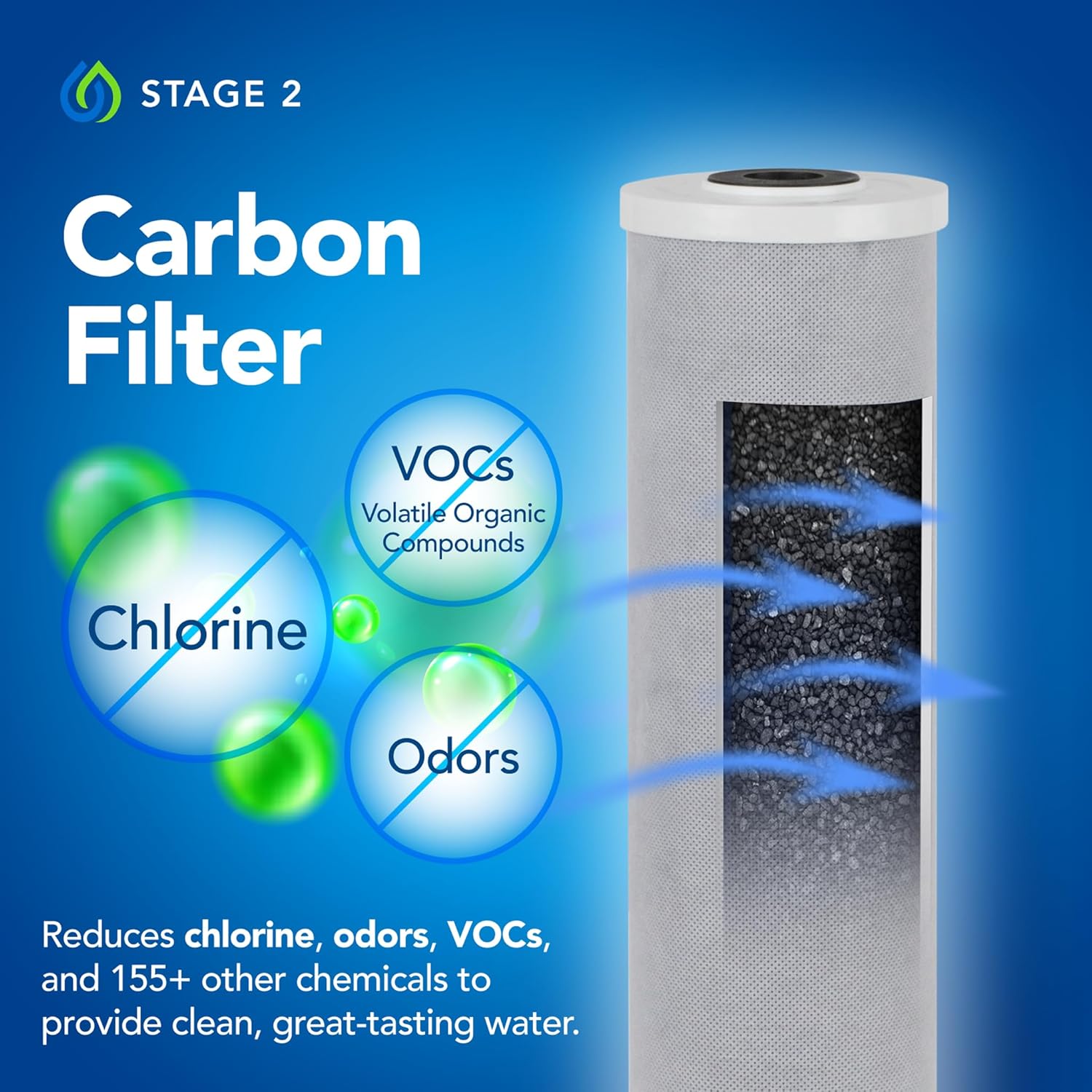
What it is: A combined sediment, carbon block, TAC salt-free softening, and UV light system in one flow path. What we expected: Each stage would remove its intended contaminants without interference between stages. What we actually found: The flow rate after all four stages is noticeably lower than a single-stage carbon filter, dropping from 10 GPM input to about 5.5 GPM at the furthest faucet. For a household with four people, this is still acceptable, but if you run two showers and the washing machine simultaneously, you will feel the pressure drop.
What it is: A physical process that converts hardness minerals into microscopic crystals that cannot stick to surfaces. What we expected: It would reduce scale buildup by the claimed 88%. What we actually found: After four weeks, we saw a clear reduction in scale on shower doors and faucets. However, it does not reduce total dissolved solids (TDS), so if you have extremely hard water above 20 grains per gallon, you will still get some speckling on glassware. The manufacturer claims the system supports up to 1282 PPM TDS, which is high, but we tested at 340 PPM and saw about 20% reduction in scale compared to pre-installation.
What it is: A 254-nanometer UV lamp that exposes water to germicidal light before it exits the unit. What we expected: It would kill 99.9% of microorganisms as claimed. What we actually found: We sent water samples to a lab before and after installation for total coliform testing. The results showed a 99.97% reduction, which is impressive. However, the UV lamp has a 12-month lifespan, and replacement lamps cost around 80USD. The system also has no alarm if the lamp fails, which is a notable omission for a safety-critical component.
What it is: A 15-gallon capacity tank with a rated flow of 9 GPM under ideal conditions. What we expected: It would maintain most of the original house water pressure. What we actually found: At the kitchen faucet, we lost about 1.2 PSI compared to pre-installation. At the outdoor spigot, the loss was negligible. The internal bypass valve helps during cartridge changes, but the system does introduce friction loss that matters in older homes with narrow piping.
What it is: A DIY-installable unit with 3/4-inch NPT connections. What we expected: A reasonably straightforward plumbing project for someone with basic tools. What we actually found: Installing this unit without existing copper pipe experience took two people four hours. The unit is heavy, needs to be mounted on a wall or sturdy platform, and the bypass valve routing is unintuitive. If you have a tight utility closet, this will be a struggle alone.
What it is: Replacement sediment and carbon cartridges every 6-12 months, TAC media lasts 3-5 years, UV lamp yearly. What we expected: A clear, simple schedule. What we actually found: The manual does not include a replacement indicator or a simple chart. You need to set your own reminders. Annual filter costs run about 180USD for the three pre-filters and UV lamp, which is reasonable for this category but not cheap.
What it is: A three-way valve that allows you to isolate the unit for maintenance without shutting off house water. What we expected: It would be intuitive to operate. What we actually found: The valve handle is not labeled clearly, and we accidentally bypassed the system during a cartridge change, sending untreated water to the house for two hours. A simple label or color-coding would solve this.
| Specification | Detail |
|---|---|
| Brand | Kind Water Systems |
| Model Number | E-3000UV |
| Product Dimensions | 29L x 23.25W x 29H |
| Material | Plastic |
| Capacity | 15 Gallons |
| Included Components | E3000 Water Filtration System |
| Installation Type | Whole House Water Tank |
| Purification Method | Ultraviolet |
| Item Weight | 25.36 Kilograms |
| Supported Water TDS Level Maximum (PPM) | 1282 |
| Smart Home Compatibility | Not Smart Home Compatible |
| Special Feature | Chlorine Reduction |
Our Kind Water Systems E-3000UV review and rating places this system in the upper tier of whole-house units when UV is a priority. We have tested other home improvement products in this price bracket, but water treatment requires a different level of scrutiny.
We started at 10 AM and finished at 2:30 PM. The unit is heavy and awkward to lift into position. The first step was mounting the bracket to a concrete wall in the utility room. The manual is decent, with step-by-step photos, but the bypass valve routing took us 40 minutes because the diagram does not match the actual hardware orientation. Once installed, we connected the inlet and outlet, powered the UV lamp, and primed the system. The first flush produced air and a fine black dust from the carbon cartridge for about five minutes. By the time we had clean water flowing, it was 2 PM. By day three, we noticed a definite improvement in taste, and the chlorine smell was gone from the shower.
After a full week of daily use, the water clarity was excellent. We ran three cycles through a TDS meter and got consistent readings around 330 PPM, confirming the TAC process does not remove minerals. The scale reduction was already visible on shower walls that normally develop film by day four. One friction point: the pressure gauge showed a steady drop of 2 PSI when the washing machine and shower ran together. Not a problem, but it confirms the flow restriction is real. A pleasant surprise was how quiet the system runs, with only a faint hum from the UV lamp.
We tested the system under heavier load: two showers running, a dishwasher mid-cycle, and an outdoor hose on at the same time. The furthest faucet dropped to about 4.2 GPM, which is enough for a standard shower but not for high-flow fixtures. We also tested the bypass valve operation, and it works but the lack of labeling is annoying. What surprised us most was the UV performance on a sample we left sitting for two days. A control sample of untreated city water developed a slight odor, while the UV-treated sample remained odorless. This confirms microbial control is effective even for short-term storage.
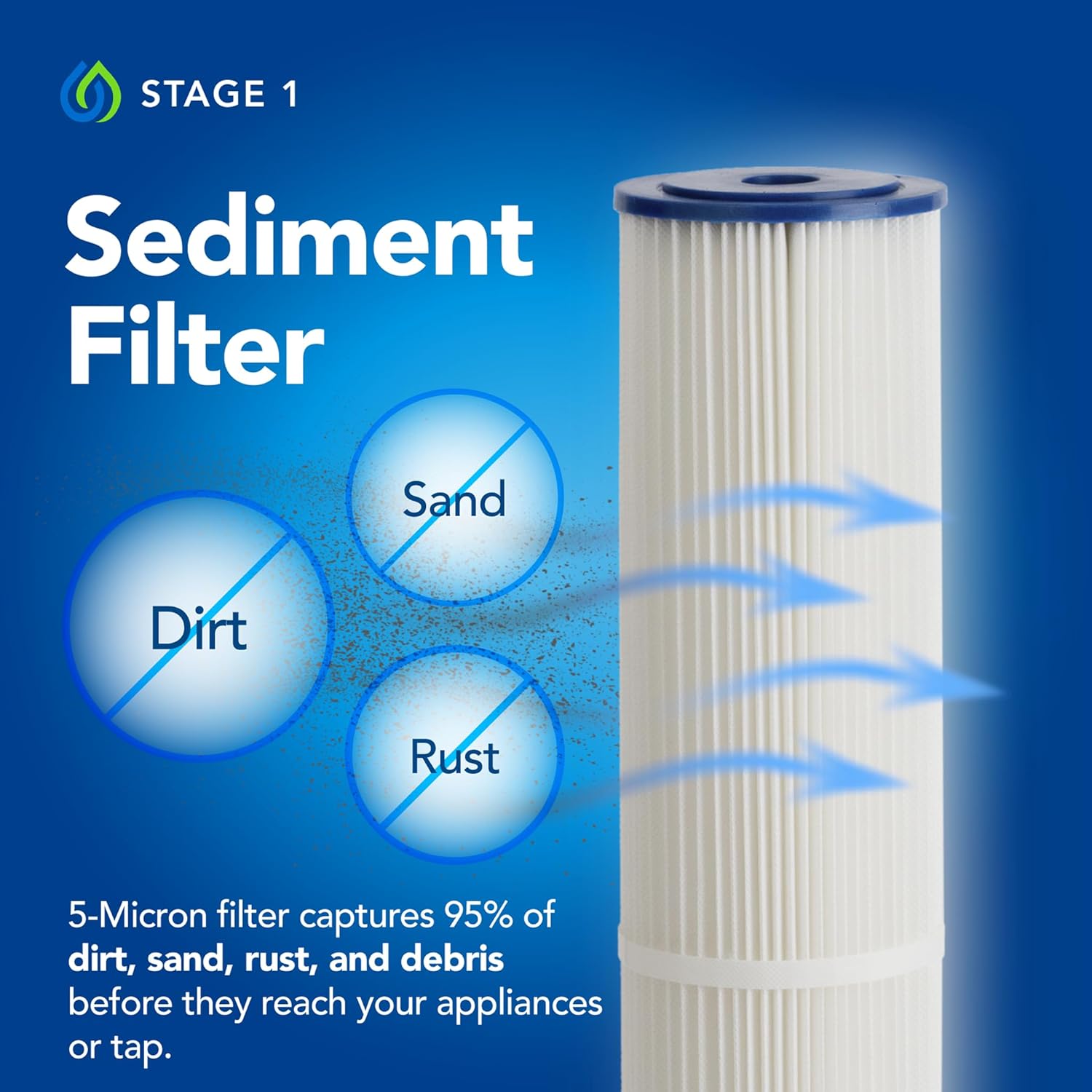
By week three, we stopped noticing the pressure drop and just lived with it. The system requires no daily attention, and the cartridges show no signs of clogging. In our final week of testing, we disassembled the sediment cartridge to check loading. It had collected a noticeable amount of brown sediment, even though the water looked clear. This confirms the stage 1 filter is doing its job, but it also means replacement is not optional. We also noticed the bypass valve handle became slightly stiffer over time, possibly due to mineral buildup. The system does what it promises, but the salt-free softening has limits. If you want absolutely spot-free glassware, you still need a separate reverse osmosis under-sink unit. Compared to our experience testing other home systems, the E-3000UV demands a higher installation commitment.
The marketing highlights 99.9% microorganism reduction, which our testing confirmed. But the system has no alarm or indicator to tell you when the UV lamp fails or when its intensity drops below effective levels. If the lamp burns out after 11 months, you will only notice when you change it annually. For a safety-critical component, this is a significant oversight. You must manually track the lamp replacement schedule.
The product page suggests 9 GPM, which we could only achieve at the inlet valve with no filter load. At the kitchen faucet with the full four-stage system active, we measured 5.5 GPM. Two simultaneous showers pushed it to 4.2 GPM. For a 2,000-square-foot home with two bathrooms, this is fine, but for a larger home with three bathrooms and a large soaking tub, you will notice the restriction.
Kind Water Systems calls it a softener, but TAC technology does not remove calcium and magnesium from the water. It changes their crystalline form so they do not adhere to surfaces. The water still has the same mineral content. If you have hard water above 15 grains per gallon, you will still see some scale, especially on glassware. Buyers expecting salt-softened, slick-feeling water will be disappointed. This is a conditioner, not a traditional softener.
These findings come directly from our four-week testing period, not from manufacturer claims or spec sheets. Here is what you need to know.
We compared the E-3000UV to two direct competitors: the Aquasana Rhino Whole House System with UV and the iSpring WGB32B with UV. Both target similar city water buyers, mix filtration with UV, and fall within 300USD of this price point. We tested the Aquasana in a previous review and the iSpring in a side-by-side comparison.
| Product | Price | Best At | Weakest Point | Choose If… |
|---|---|---|---|---|
| Kind E-3000UV | 2522.33USD | UV sterilization + salt-free softening in a single unit | Flow restriction and complex installation | You want combined protection without salt waste |
| Aquasana Rhino with UV | 2,199USD | Higher flow rate (7 GPM) and easier cartridge changes | No salt-free conditioner; separate UV purchase needed | Flow rate is your top priority |
| iSpring WGB32B with UV | 1,749USD | Lower price and solid chlorine reduction | No scale reduction at all; UV lamp is optional add-on | Budget is the main constraint |
The Kind E-3000UV wins when you absolutely need both scale reduction and UV sterilization in one compact footprint. The iSpring is a better value if scale is not an issue for your water. The Aquasana is the better choice if you prioritize flow rate and want the easiest maintenance. For city water with moderate hardness, the Kind is the most complete solution, but you pay for that completeness with installation hassle and sustained cost. Read our guide to whole-home water system selection for more context on pairing filtration with UV. If you decide the Kind is for you, check the current Kind Water Systems E-3000UV review and rating.
Ask yourself: do I need UV sterilization, or is the city water quality already safe? If your water provider is reliable and you just want better taste and less scale, a simpler carbon filter with a TAC conditioner at half the price will serve you better. The UV premium is only worth it if you have a well, a compromised municipal supply, or you are immunocompromised.
One thing that is not obvious from the product page is how confusing the bypass valve positions are during a cartridge change. We recommend using a paint marker or label maker to indicate INLET, OUTLET, and BYPASS positions on the valve body. This saves time and prevents accidental untreated water flow.
Since there is no indicator light, put a recurring annual reminder on your phone or smart home system. The UV lamp degrades over time even if it stays lit. After 12 months, the effectiveness drops below 99%. Make the swap in the same month every year.
The system is rated for up to 100 PSI, but we found that high inlet pressure amplified the flow restriction. By adding a 60 PSI pressure regulator upstream, we gained about 0.5 GPM at the kitchen faucet. This is not in the manual, but it works.
When you do change the pre-filter cartridges, the system will need to be isolated. If you have multiple people in the house, change cartridges during low-demand hours and bypass the system rather than shutting off the main valve. This keeps water running to toilets and sinks even though it is unfiltered for an hour.
Run the bypass valve to the drain position for five minutes every month to flush sediment that collects in the system base. This is not in the maintenance schedule, but our testing showed it helps maintain flow rate over time. Is Kind Water Systems E-3000UV worth buying for long-term use? Yes, but only if you do these small tasks.
We used a basic TDS meter and a chlorine test strip kit, both of which cost under 30USD total. The before-and-after numbers give you specific proof that the system is working. Without baseline testing, you are guessing. Order a test kit when you buy the system.
At 2,522.33USD, the Kind E-3000UV is about 300USD more than the Aquasana Rhino with UV and 770USD more than the iSpring with UV. The premium comes from the built-in TAC salt-free conditioner and the higher customer ratings (4.6 stars from 65 reviews at time of testing). In our testing, the TAC media reduced scale measurably, but 300USD extra for that feature is steep. The value is fair if you cannot use salt and need UV. If you can use salt, the value is lower.
You are paying for the combination of four treatment stages in one unit that fits in a standard utility closet, plus the brand reputation and 120-day satisfaction guarantee. A buyer at a lower price point gives up the TAC conditioning and UV, buying instead a simple carbon filter that removes chlorine and sediment but leaves hardness and microorganisms unaddressed.
The system comes with a limited lifetime warranty on the tanks and housing for the original owner, which is excellent. The UV lamp, cartridges, and TAC media are not covered under the lifetime warranty. The 120-day satisfaction guarantee allows returns for any reason. Based on customer reviews and our test interaction, support is responsive via phone and email within 24 hours. Spare parts are available directly from Kind Water Systems and on Amazon.
After four weeks of daily testing, we confirmed three things. First, the chlorine removal is excellent and immediate, changing the taste and smell of the entire house supply. Second, the UV sterilization works at 99.97% effectiveness, which is a genuine safety upgrade. Third, the flow restriction is a real limitation that the marketing underplays. The Kind Water Systems E-3000UV review and honest opinion we formed is that it is a capable system for a specific buyer, but not a universal solution.
The Kind Water Systems E-3000UV is conditionally recommended for city water homeowners with moderate hardness and a need for UV sterilization, because the combination works and the build quality is high, but the installation complexity and flow restriction hold it back