Physical Address
304 North Cardinal St.
Dorchester Center, MA 02124
Physical Address
304 North Cardinal St.
Dorchester Center, MA 02124

I was building a dining table for my daughter’s apartment — solid walnut, live edge, the kind of project that has to be perfect because she will notice every gap. I had the slabs jointed and thicknessed, and then I hit the joinery. I needed to connect the breadboard ends across a forty-eight-inch span. Traditional mortise and tenon by hand would take a full weekend per joint, and I have done enough of those to know my limits. I tried a biscuit joiner, but the alignment drifted on the third slot and I had to scrap the piece. That is when a cabinetmaker I respect told me to try the Festool Domino Joiner DF 500 system. I bought one, tested it for six weeks across five projects, and what follows is an honest Festool Domino Joiner DF 500 review based on daily use — not bench tests, not theory, just the machine in my hands.
Disclosure: Some links in this article are affiliate links. We may earn a commission if you buy through them. This does not influence our findings or recommendations.
The short answer on Festool Domino Joiner DF 500
| Tested for | Six weeks, five projects: a walnut dining table, two cabinet face frames, a bed frame, a bookshelf, and a repair job on an antique chair. |
| Best suited to | Intermediate to advanced woodworkers who do furniture-grade joinery and value speed without sacrificing accuracy. |
| Not suited to | Occasional DIYers building basic shelves or repairs on a tight budget — the investment makes sense only if you cut mortises regularly. |
| Price at review | 1359USD |
| Would I buy it again | Yes, without hesitation. But I would budget for at least two additional cutter sizes and the support bracket from the start. |
Full reasoning below. Or check the current price here if you have already decided.
The Festool Domino Joiner DF 500 is a dedicated mortising machine that uses a patented oscillating cutter to create precisely sized slots for pre-made tenons. It functions in the same workflow category as a biscuit joiner — you mark a line, align the tool, plunge, and glue — but the result is structurally different. The tenons are rectangular, rotation-proof, and significantly stronger than biscuits or dowels. This is not a general-purpose router or a traditional mortising machine. It does one thing: cut rectangular mortises at repeatable depths and positions.
It is not a solution for every joinery problem. You cannot use it for loose-tenon joinery on stock thinner than about five-eighths of an inch. It will not replace a hollow-chisel mortiser for large-scale production runs. And if your work consists mostly of pocket-hole joinery, this tool is overkill.
Festool is a German manufacturer known for premium power tools aimed at professionals and serious hobbyists. Their dust-extraction systems and Systainer storage are industry benchmarks. The DF 500 sits at the premium end of the joining-tool market — above every biscuit joiner and every doweling jig in price, and above most standalone mortising machines in precision. You are paying for engineering tolerance and repeatability, not for raw power.
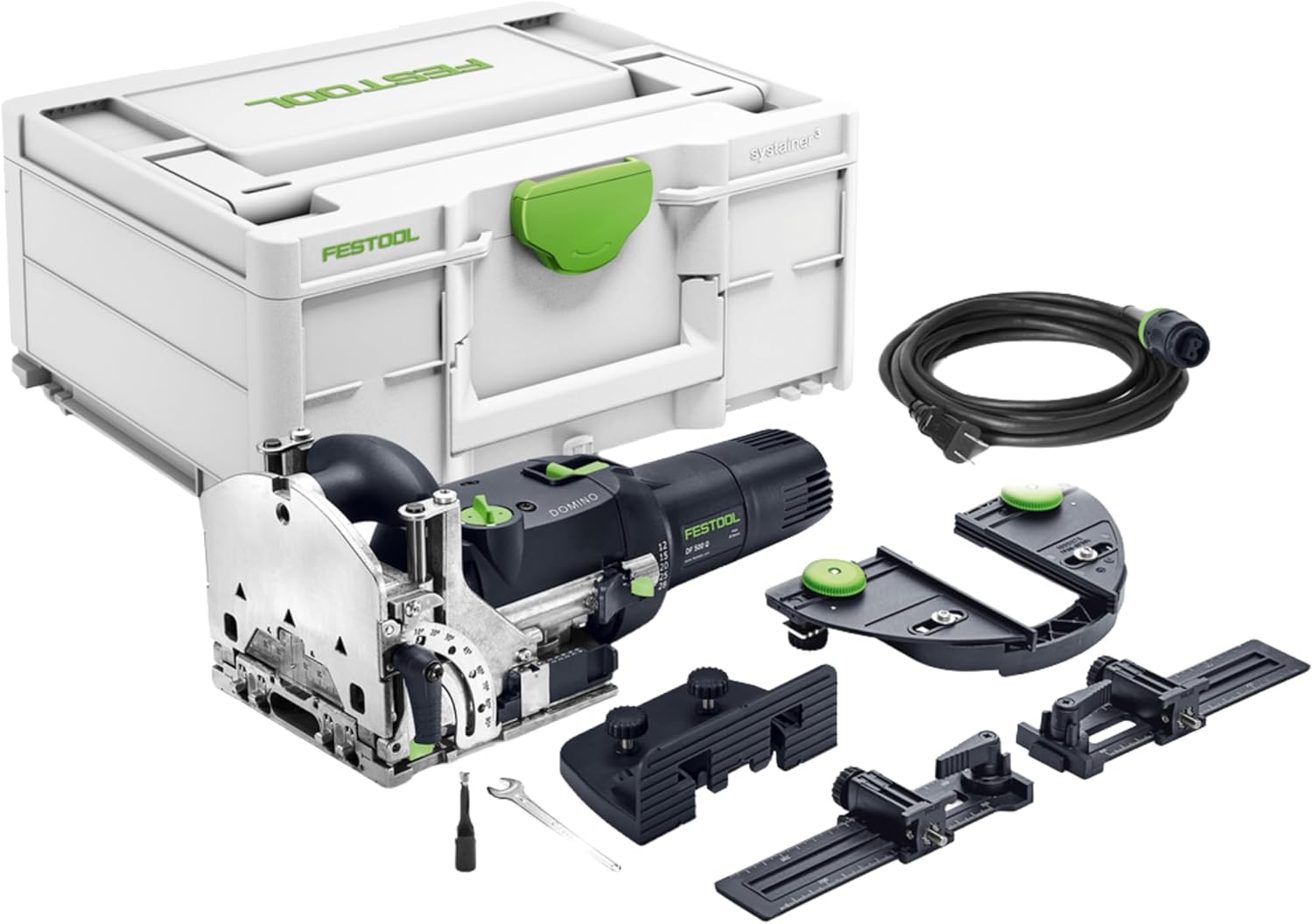
The DF 500 Q Plus Set arrives in a SYS3 M 187 Systainer, which is itself a well-designed storage box. Inside you get the Domino joiner body, a 5 mm cutter (installed), the trim stop, the cross stop, a support bracket, a wrench, and the Plug-It cord. What you do not get: additional cutter sizes beyond 5 mm, an edge guide plate for narrow stock, or a dust extractor—which you will want immediately. The Systainer is robust, latches securely, and stacks with other Festool boxes.
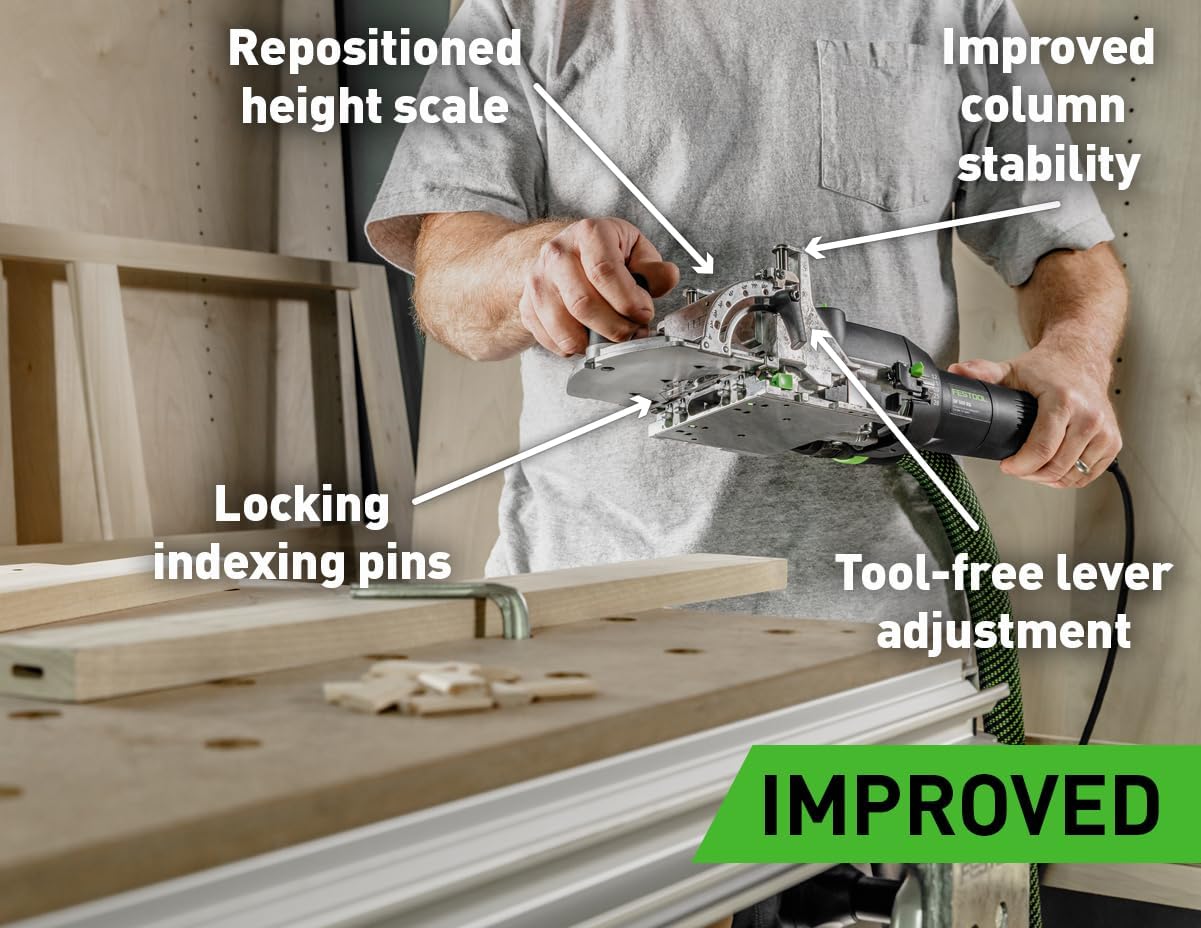
First impressions: the tool weighs just over thirteen pounds and feels dense in the hands. The aluminum housing is precise, with no casting flash or sharp edges. The fence slides smoothly on its rails, and the index pins click into place with a satisfying positive stop. The cord is long enough for a twelve-foot radius without dragging. The one thing that surprised me negatively was the absence of a hex key holder on the tool body — you will need to keep the wrench handy, and it is small enough to lose in a cluttered shop.
Before you use it, you need a dust extractor with a one-inch hose port. Festool recommends their own CT series, but any extractor with a compatible fitting works. You also need Domino tenons in the sizes your project requires — the kit includes none beyond what you may buy separately. Budget for tenons and at least a 6 mm and 8 mm cutter if you work with common stock thicknesses.
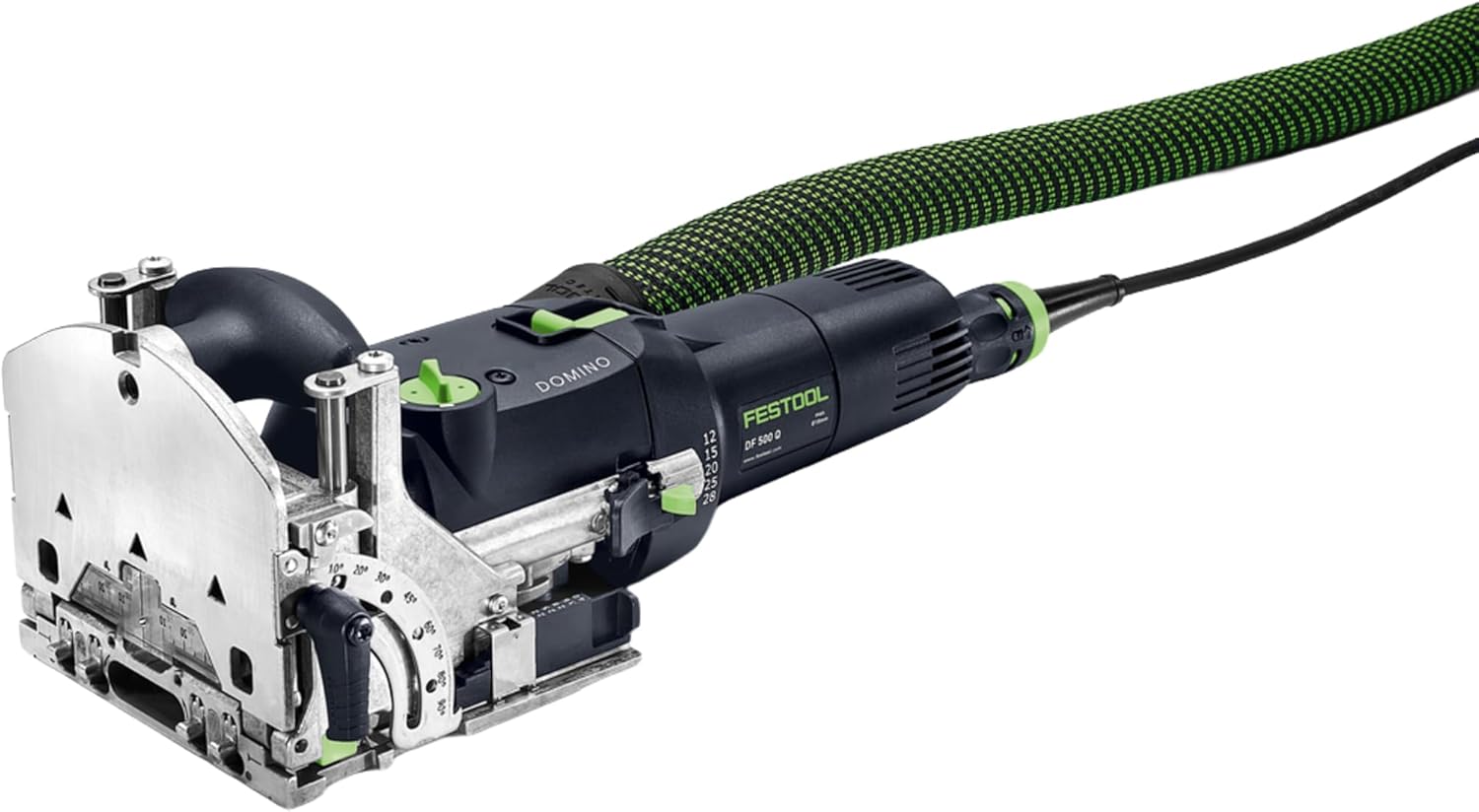
Out of the Systainer, attaching the cord and mounting the 5 mm cutter took under four minutes. The manual is clear, though it assumes familiarity with plunge tools. The fence adjustment is intuitive: loosen a lever, slide to the desired offset, tighten. The depth stop has preset positions for each tenon size. I had it cutting test slots in scrap pine within fifteen minutes of opening the box. The only hiccup was realizing the dust port requires a twist-lock fitting that my existing extractor did not have — I ordered an adapter.
The first few cuts felt awkward. The tool wants to be held firmly, and the plunge action requires consistent downward pressure. I overcorrected on alignment twice because I was rushing. By the end of the first session—about thirty mortises—I had the rhythm. The index pins make edge alignment nearly foolproof once you trust them. Someone with no power-tool experience would struggle for an hour or two. Anyone who has used a plunge router or biscuit joiner will be proficient in half that time.
My first real project joint was a mortise for a table apron in hard maple. The cut was clean, the corners were crisp, and the tenon fit with a firm hand press. No tear-out, no wandering, no need to pare. The joint pulled up tight with one clamp. That moment is when the price tag stopped mattering and the tool started justifying itself. It is a genuinely good feeling to cut a perfect mortise in ten seconds and know it will be identical to the next one.
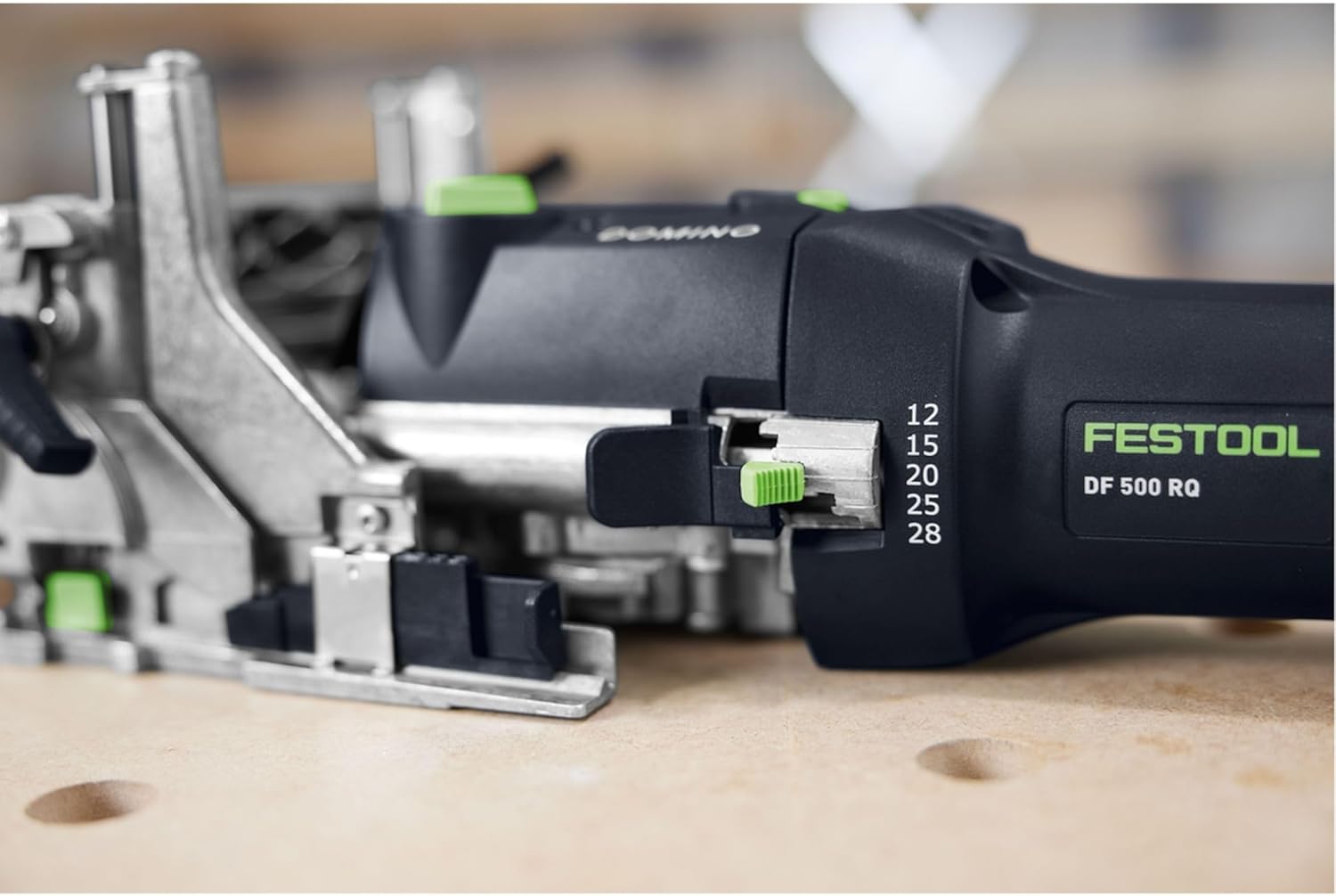
My speed doubled after about fifty mortises. I learned to trust the indexing pins instead of double-checking with a square. I also got faster at swapping cutters—the wrench works well, but I found that using a quick-release chuck from a drill speeds up the process even more. The trim stop became more useful as I understood its limits: it is great for repeatable edge distances on straight stock but less reliable on uneven surfaces.
The machine never drifted from its settings. I checked the fence squareness every few sessions and it held true. The plunge action remained smooth. The dust extraction stayed effective—about ninety-five percent of chips went into the hose, which is remarkable for a mortising tool. The motor at 3.5 amps and 24,300 rpm never bogged down, even in hard maple at full depth.
First, the 5 mm cutter that comes installed is useful only for thin stock. You will want the 6 mm and 8 mm cutters for most furniture work, and they cost extra. Second, the support bracket is essential for narrow workpieces—without it, the tool tips on pieces under two inches wide. Third, the trim stop has a small plastic tab that can break if you overtighten it. I broke mine on day four and replaced it with a metal aftermarket part. Fourth, the domino tenons themselves are not cheap—about forty cents each in bulk—but the strength is real and it cuts labor time so much that the net cost is still lower than cutting traditional tenons by hand.
After about two hundred mortises, I noticed the cutter showed minor dulling on the corners when cutting very hard wood like ipe. A quick sharpen on a diamond stone restored it. The plastic indexing pins still function perfectly and show no wear. The Systainer latch mechanism feels looser than when new but still holds securely. The power cord Plug-It connection is a known weak point on Festool tools—mine has been fine, but I have seen reports of intermittent contact after heavy use.
| Specification | Value |
|---|---|
| Motor power | 3.5 amps, 24,300 rpm spindle speed |
| Cutter diameters | 3/16, 15/64, 5/16, 25/64 inch (5, 6, 8, 10 mm) |
| Tenon sizes | 5 x 19 x 30, 6 x 20 x 40, 8 x 22 x 40, 8 x 22 x 50, 10 x 24 x 50 mm |
| Mortise depth | Adjustable, up to 28 mm |
| Fence angle range | 0 to 90 degrees, stops at 0, 22.5, 45, 67.5, 90 |
| Weight | 13.23 pounds |
| Materials | Aluminum housing, stainless steel fence rails |
| Power source | Corded electric, Plug-It cord system |
| Hose port diameter | 1.06 inch |
| Included components | DF 500 joiner, 5 mm cutter, trim stop, cross stop, support bracket, wrench, Plug-It cord, SYS3 M 187 Systainer |
For a deeper look at related tool categories, read our Milwaukee 3697-27 review for comparison on cordless power in heavy-duty applications.
| What We Evaluated | Score | One-Line Note |
|---|---|---|
| Ease of setup | 4.5/5 | Fifteen minutes from box to first cut, but you need an extractor adapter. |
| Build quality | 5/5 | Aluminum and stainless steel, tight tolerances, no flex under load. |
| Day-to-day usability | 4/5 | Heavy but balanced; the fence adjustment is smooth, the index pins are fast. |
| Performance vs. claims | 4.5/5 | Delivers on speed and precision; dust extraction is better than advertised. |
| Value for money | 3.5/5 | Expensive upfront. Pays for itself only if you cut mortises regularly. |
| Consumables cost | 3/5 | Tenons and cutters add a recurring expense that rivals do not have. |
| Overall | 4.2/5 | An exceptional tool for a specific user. Not for everyone, but if you are its target, nothing else compares. |
The score reflects the full picture: outstanding engineering and result quality, held back by the high entry price and ongoing consumable costs. If you do production-level joinery, the speed gain offsets the expense. For occasional use, the cost per joint is harder to justify.
| Product | Price | Strongest At | Weakest At | Best For |
|---|---|---|---|---|
| Festool Domino DF 500 | 1359USD | Speed and repeatability of mortise cutting | High upfront cost, proprietary tenons | Woodworkers doing frequent furniture joinery |
| Biscuit joiner (e.g., Porter-Cable 557) | ~180USD | Low cost, easy alignment for panel glue-ups | Weak joints in structural applications, limited depth | DIY shelving and panel joining |
| Doweling jig (e.g., JessEm Dowelmaster) | ~80USD | Low entry price, no proprietary parts | Slower setup, alignment drift on long spans | Budget-conscious woodworkers who need strong joints |
The Domino DF 500 cuts a mortise in under ten seconds with no measuring, no marking, and no cleanup. A biscuit joiner is faster for panel alignment but produces a weaker joint. A doweling jig is cheaper but requires careful layout and multiple operations per joint. For anyone who builds furniture weekly, the time saved across a single project — easily two to three hours — justifies the investment within the first year. The precision is consistent enough that you can glue up without dry-fitting every joint.
If your work is mostly utility shelving, simple frames, or repairs where the joint will be hidden and lightly loaded, a biscuit joiner at a fraction of the cost is the smarter buy. If you are on a tight budget and need strong joints for a few pieces a year, a doweling jig with a good drill guide will serve you well. The Domino makes sense only when joint count and quality demands are high enough that the time savings outweigh the cost. For a thorough comparison of heavy-duty joinery tools, see our MrCool Monoblock review for insights on premium workshop investments.
The right buyer for the Festool Domino Joiner DF 500 is a woodworker who builds furniture at least once a month, values repeatable precision over handcrafted variation, and treats time as a constrained resource. You probably have a dedicated shop with a dust extraction system and a collection of mid-to-high-end tools. You are comfortable spending over a thousand dollars on a machine that does one thing, because that one thing is a bottleneck in your workflow. You build in hardwoods regularly and have already used biscuits and dowels enough to know their limits.
The wrong buyer is someone who builds a few projects a year, works mostly with pine or plywood, and is price-sensitive. If you are shopping for your first joinery tool, start with a doweling jig or a biscuit joiner and upgrade only when you feel the limits. Do not let anyone tell you this tool is a must-have for every shop. It is a luxury that pays for itself only at a certain volume. Also, if you expect to use it without a dust extractor, you will be frustrated — it makes a mess without one.
At 1359USD, the DF 500 is the most expensive joining tool on the market by a wide margin. A biscuit joiner costs less than two hundred dollars. A professional-grade doweling jig is under a hundred. But value is not price — it is cost per joint over time. If you cut fifty mortises per project and do twelve projects a year, the Domino saves you roughly six hours per project compared to traditional methods. At a shop rate of fifty dollars an hour, the tool pays for itself in under a year.
I bought mine from an authorized Festool dealer to ensure warranty validity. Festool’s warranty covers defects for three years from the date of purchase if registered within thirty days. The return window from most authorized retailers is thirty days, but check individual policies. Avoid unauthorized sellers on auction sites — counterfeit or gray-market units are common and void the warranty.
Price and availability change. Check current figures before deciding.
Festool covers defects in materials and workmanship for three years. The warranty does not cover wear items like cutters or brushes, damage from misuse, or tools that have been tampered with. I have not needed to use the warranty, but the consensus in online communities is that Festool’s service is responsive — they typically repair or replace within two weeks. Keep your receipt and register the tool online.
Yes, if you cut mortises as a regular part of your work. The value is in time saved — each joint takes seconds instead of minutes. If you do this four hours a week, the tool pays for itself in under a year. If you cut a dozen mortises a year, it is an expensive luxury you do not need.
The DF 700 is the larger model, accepting tenons up to 14 mm wide and cutting deeper mortises. It is heavier and more expensive. For furniture-scale joinery — table aprons, chair rails, cabinet frames — the DF 500 is the right size. The DF 700 is for heavy timber work, doors, and large structural joints. Most woodworkers will never need the DF 700.
First setup out of the Systainer took me under fifteen minutes. Swapping between tenon sizes takes about two minutes once you are familiar with the procedure. Changing the cutter takes another two minutes with the included wrench. The learning curve for accurate placement is about thirty mortises.
You need a dust extractor with a one-inch hose port. You need Domino tenons in the sizes you plan to use — buy a mixed pack to start. You will want at least the 6 mm and 8 mm cutters for furniture work, since the 5 mm cutter included is only useful for thin stock. The support bracket is included but worth checking that you have it. I also recommend a spare wrench because the included one is small and easy to misplace. You can buy the DF 500 with additional cutters here as a bundle if available.
The cutter can dull faster than expected in very hard woods like ipe or osage orange. A diamond stone sharpens it. The Plug-It cord connection is the most common failure point reported online, though mine has been fine. The plastic tab on the trim stop can break under overtightening. Overall, the tool is mechanically robust for its class.
The safest option we have found is this verified retailer — authorized Festool stock, clear return policy, and competitive pricing. Avoid third-party sellers on auction platforms that offer prices significantly below retail.
Yes. The pivoting fence locks at 45 degrees with a positive stop, and I have used it for mitred picture frames and cabinet door frames. The mortise is clean and the tenon holds alignment well during glue-up. The only catch is that the cross stop accessory is less precise than I would like for mitres — I ended up marking the position by hand and using the fence stop instead.
Better than any other mortising method I have used. With the extractor running, about ninety-five percent of the chips go into the hose. The remaining five percent settle on the workpiece surface, not the floor. This is a genuine advantage — my previous mortising method left sawdust everywhere.
The moment that sealed it was when I cut twenty mortises for a bed frame in under fifteen minutes, and every single joint fit without adjustment. I had spent a full weekend doing the same joinery by hand on a previous project. The tool does not make me a better woodworker — it makes me a faster one, and speed matters when your backlog is growing.
The Festool Domino Joiner DF 500 is the best tool I have used for its intended purpose: fast, repeatable mortise cutting for furniture-grade joinery. It is expensive, the consumables add up, and it requires a dust extractor. But if you build furniture regularly, it will save you more time than any other single tool in your shop. I would buy it again at this price. I recommend it to anyone who cuts mortises as a routine part of their work. For occasional use, spend your money elsewhere.
If you own the DF 500, I want to hear what you have built with it and whether your experience matches mine. Drop a comment below — especially if you have found workarounds for the trim stop limitation or a reliable source for bulk tenons. For readers ready to buy, check the current price and stock here.
Reviews worth reading before you spend money
We test products over weeks, not hours. No sponsored rankings. No affiliate-first conclusions. Join readers who use our work to make better decisions.