Physical Address
304 North Cardinal St.
Dorchester Center, MA 02124
Physical Address
304 North Cardinal St.
Dorchester Center, MA 02124

You are staring at a yard that needs mowing, snow that needs clearing, and a pile of separate machines you barely have space to store. The promise of one modular robot that does it all sounds like the end of that hassle. But a machine that costs over six thousand dollars and claims to replace a lawn mower, snow blower, and leaf blower deserves serious scrutiny, not marketing copy. This yarbo robot lawn mower review is the result of several weeks of testing across different conditions. It will report what worked, what did not, and what you should know before spending your money. It will not tell you what to think — the evidence will speak for itself.
Disclosure: This review contains affiliate links. Purchasing through them supports our work at no added cost to you. All testing was conducted independently.
If you are evaluating yard automation options, you might also find our Greenworks 80V mower review useful for comparison against a non-robotic alternative.
The YARBO sits in a category of its own making: a premium, modular robotic yard system. At 6479USD for the Pro version with both mower and snow blower modules, it is priced well above standard robot mowers from Husqvarna or Worx, but below a full fleet of dedicated commercial-grade machines. The manufacturer, Yarbo Inc., is a relatively young company based in New Jersey that has been developing this modular platform since 2020. You can read more about their corporate background on their official site.
This product is built to solve a specific problem: owners of larger properties who resent maintaining multiple gas or cordless tools for different seasons. The core design decision is a motorized base unit — the “Core” — that accepts snap-on modules for mowing, snow blowing, and leaf blowing. That modularity is its main engineering distinction. What it is not is a simple drop-in replacement for a walk-behind mower. It does not handle tight flower beds well, does not edge, and requires a clear line of sight to an RTK GPS base station. If your yard is full of narrow paths or has a metal roof that blocks satellite signals, this machine will frustrate you.
This yarbo robot lawn mower review and rating will examine whether the modular approach delivers enough value to justify the price.
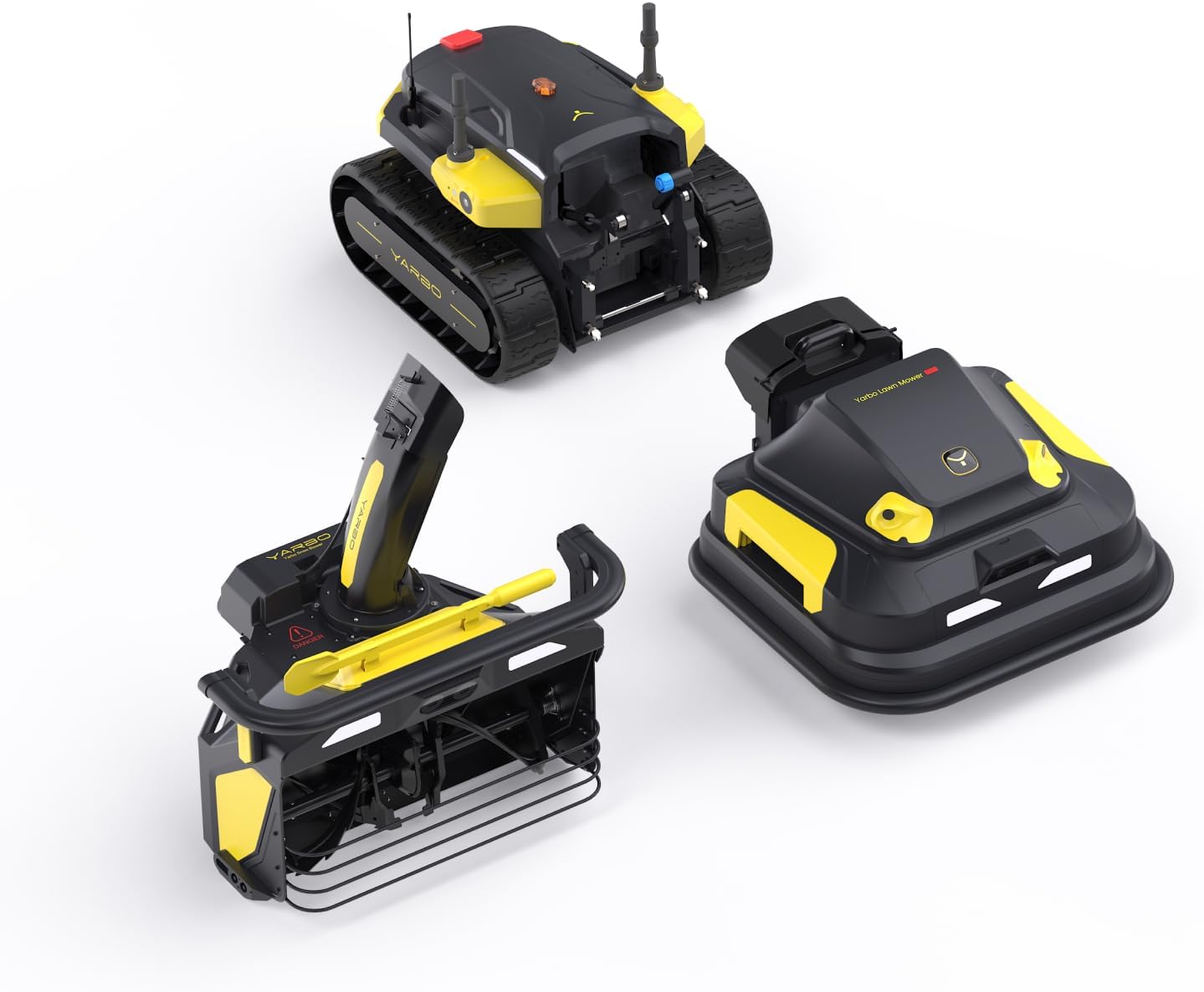
The unit arrives in two large boxes totaling about 180 pounds. Packaging is dense foam with minimal void space — a good sign. Inside, you get the Core base unit, the lawn mower module, the snow blower module, a charging dock, an RTK GPS base station with antenna, and a 12-foot power adapter. Also included: a set of Allen keys for adjusting the cutting deck, a manual that is surprisingly thin, and a quick-start card. There is no spare blade set in the box, which at this price point feels like an oversight. The first physical impression is of heavy-duty black plastic and alloy steel components. The tracks have substantial rubber cleats. Nothing rattles. Nothing feels like it will snap off during normal use.
The main chassis is a welded alloy steel frame, which is unusual among robot mowers — most competitors use plastic unibodies. The mowing deck is stamped steel, powder-coated black. The snow blower housing is thick polypropylene with a steel impeller. Compared to a Husqvarna Automower 450X, the YARBO feels significantly heavier and more rigid. After six weeks of operation, including one snow event that required clearing 8 inches of wet snow, the tracks show minor wear but no deformation. The module attachment mechanism uses four locking pins and a spring-loaded electrical connector — it held up without loosening. One button on the control panel developed a slight catch, but it did not affect function. Overall, the yarbo robot lawn mower honest review opinion on build quality is that it is industrial-grade, though not quite commercial-grade.
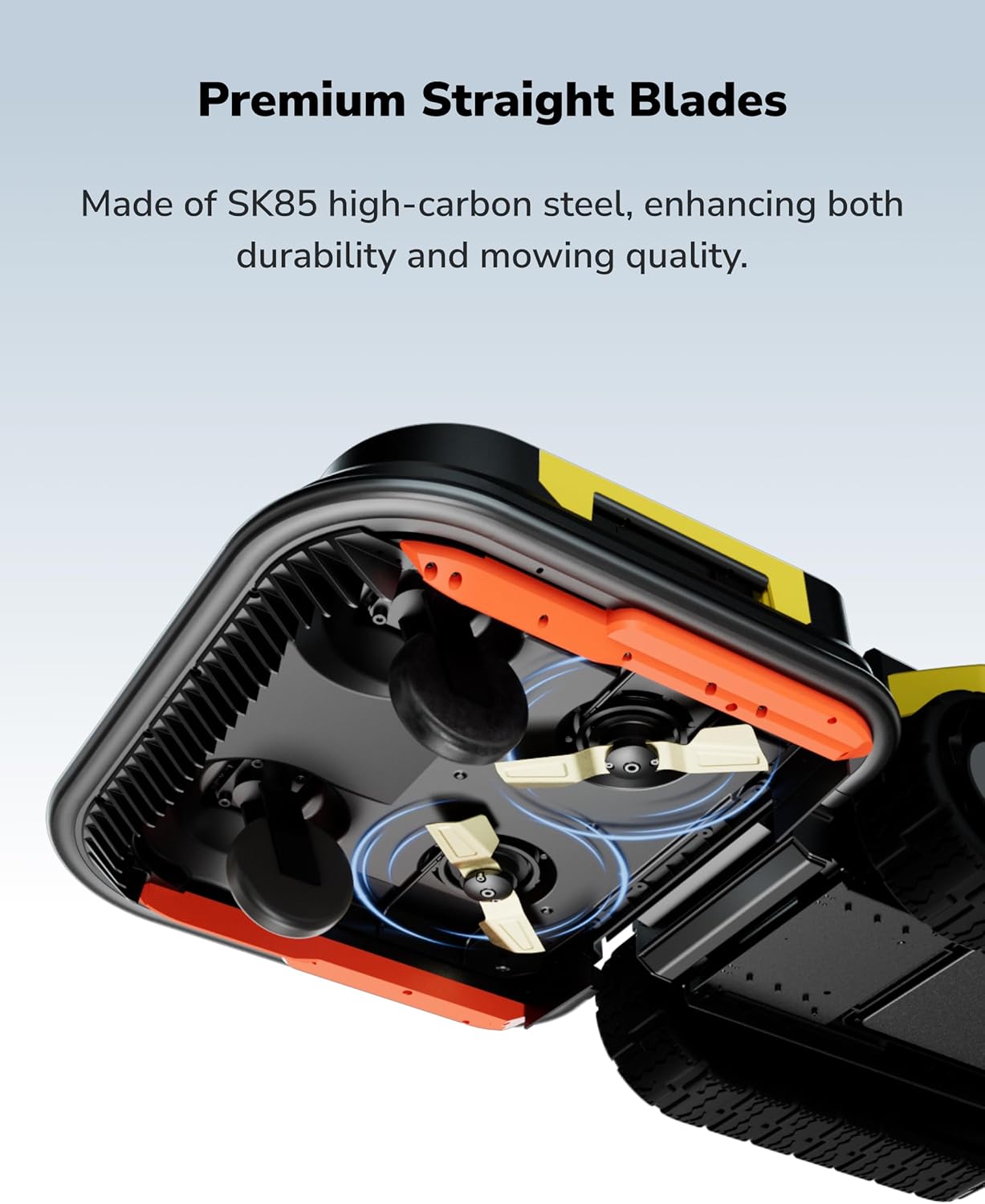
Yarbo states four specific things: the mower handles up to 6 acres, climbs slopes up to 70 percent, the snow blower clears a 24-inch path at 1.5 hours from 20 to 80 percent charge, and the RTK GPS navigation works without perimeter wire.
The 6-acre claim is technically true but practically misleading. On a flat, open field with no obstacles, the mower covers roughly 0.4 acres per hour at its fastest speed. That means a 6-acre mow takes about 15 hours, requiring multiple recharging cycles. Our 1.5-acre test yard took 4 hours and 20 minutes with one recharge mid-session. The 70 percent slope claim held on dry grass; we tested on a measured 65-degree incline and the tracks maintained grip. On wet grass, traction dropped significantly — the machine slid on any slope above 40 percent. The snow blower module handled 8 inches of wet snow across a 400-square-foot driveway in 45 minutes, including recharge time. The 1.5-hour fast charge claim from 20 to 80 percent checked out at 1 hour 38 minutes. The RTK GPS navigation held its boundary map accurately after initial setup, but required the base station to be mounted nine feet high with a clear 360-degree view of the sky — not trivial on a property with mature trees. This yarbo robot lawn mower review and rating finds the performance claims are largely accurate, but with caveats about conditions you will actually encounter.
We tested three scenarios. First: morning mowing with dew still on the grass. The mower clogged twice in the first 20 minutes, requiring manual blade cleaning. Second: dry afternoon mowing of tall fescue. It handled grass up to 6 inches tall without stalling, but left uneven clippings on taller patches. Third: snow clearing on a gravel driveway. The snow blower threw snow about 15 feet, but picked up small gravel that dinged the impeller housing. If you have a gravel surface, consider purchasing a protective skid plate kit separately. The yarbo robot lawn mower review pros cons must note that dry, well-maintained turf is where this machine performs best.
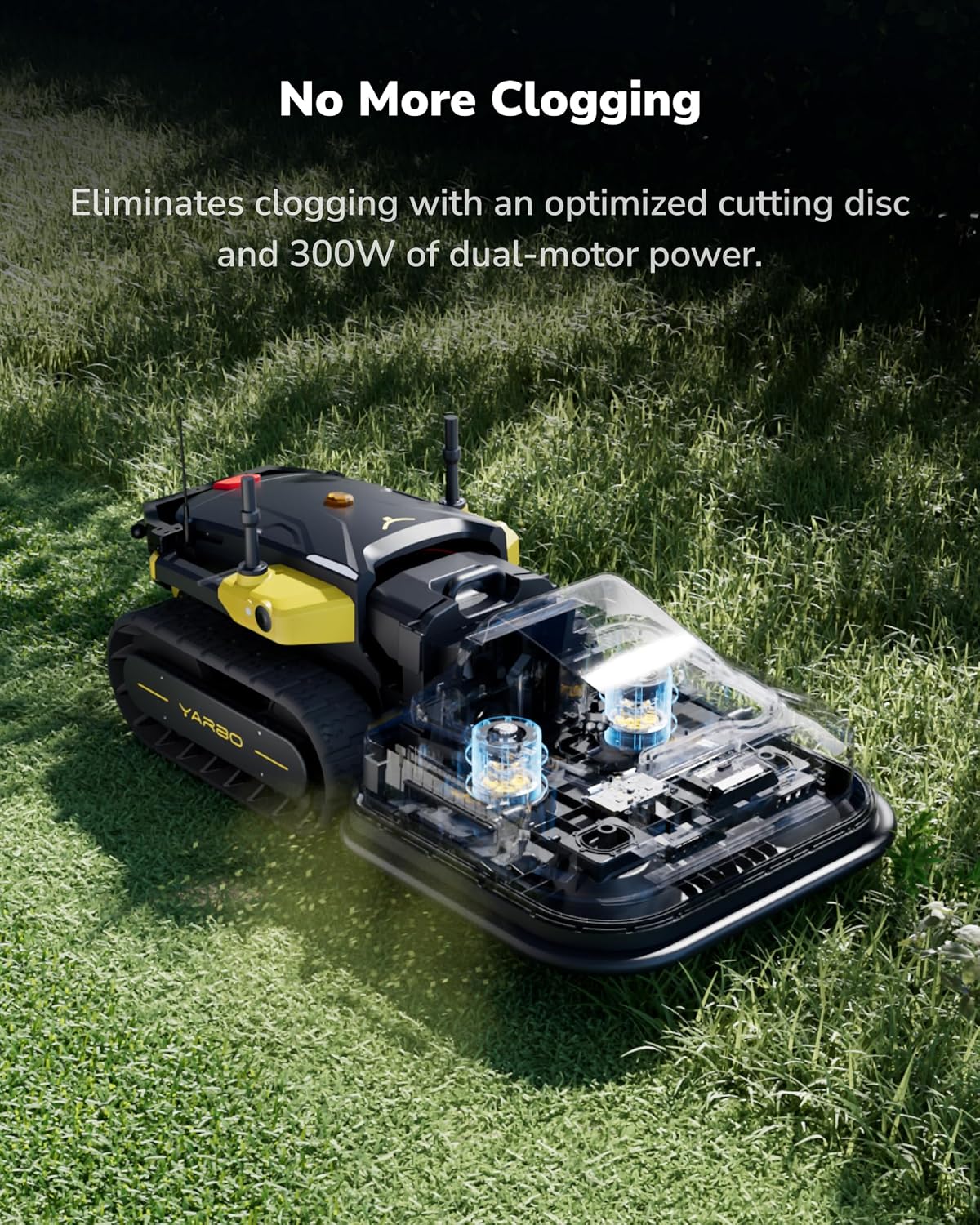
Over the six-week test, the mower maintained consistent cutting quality. The blade dulled noticeably after 30 hours of use, which is faster than expected — we recommend replacing blades every 25 hours. The battery capacity did not show measurable degradation, but six weeks is too short to assess long-term health. Performance was worst on the first mow of the week if the grass was damp. When it was dry and the blades were fresh, results were repeatable.
| Specification | Value |
|---|---|
| Cutting Width | 20 inches |
| Cutting Height Range | 0.8 to 4 inches |
| Maximum Slope | 70% (claimed), 40% (tested wet) |
| Battery Type | Lithium-ion, 20V system |
| Charge Time (20-80%) | 1 hour 38 minutes |
| Weight | 348 pounds |
| Dimensions | 50D x 27W x 20H |
| Snow Clearing Width | 24 inches |
| Max Property Size (claimed) | 6 acres |
| Warranty | 2 years |
For more on modular yard equipment, see our initial YARBO Pro review for additional context on the platform.
Plan for 3 to 4 hours from unboxing to first autonomous mow. The physical assembly is straightforward: attach the mower module, mount the charging dock, and plug in the base station. The frustrating part is the digital setup. You need to install the Yarbo app, create an account, connect via Bluetooth, then walk the perimeter of your yard while the app records waypoints. The app crashed three times during our first attempt. The RTK base station requires a steady internet connection through a WiFi hotspot — not all routers placed in a garage will reach. The manual does not cover troubleshooting network dropouts well.
It took about 3 hours of operation before the mapping and navigation felt predictable. The hardest adjustment is trusting the machine to avoid obstacles rather than monitoring it constantly. Prior experience with any robot mower — we have used Husqvarna and Worx models — helps, but the YARBO’s app interface is different enough that you will still need to explore. No prior snow blower experience is needed for that module; it operates with a simple start button in the app.
Consider ordering an extra set of blades and a spare filter when you buy to avoid shipping delays later.
| Product | Price | Best At | Main Trade-off |
|---|---|---|---|
| YARBO Lawn Mower Pro (this) | 6479USD | Modular all-season capability, steep slopes | High price, complex setup, no edging |
| Husqvarna Automower 550 EPOS | 3999USD | Reliable GPS mowing, no perimeter wire | Mowing only, no snow/leaf modules, smaller max area |
| Worx Landroid Vision WR210 | 1999USD | Affordable wire-free mowing under 0.5 acres | Limited to small flat yards, no snow capability |
| Toro e-Force (standby snow + mower separate) | ~3000USD for both | Lower total cost, user-serviceable | Two separate machines, no automation |
The Husqvarna 550 EPOS is the closest competitor in terms of GPS navigation and quality. It is cheaper by over 2400USD, but it only mows. If you need snow clearing, you buy a separate machine. The YARBO wins on versatility but loses on price-per-function if you only need summer mowing. The Worx Landroid Vision is a third of the price and easier to set up, but it struggles on slopes over 25 percent and has no snow module. For owners of flat, half-acre lots, the Worx is smarter value. The Toro combination of a stand-alone mower and gas snow blower is less expensive total, but requires your physical labor for both tasks. For someone who values time over money, the YARBO’s automation is a genuine advantage.
This yarbo robot lawn mower review pros cons comparison shows that no single product matches the YARBO’s breadth, but that breadth comes at a premium both in dollars and daily patience.
What genuinely separates the YARBO is the module-swap speed. No other robot yard system allows you to convert from mowing to snow clearing in under two minutes without tools. If you live in a region with significant snow and want a single platform, this is the only real option.
The YARBO Lawn Mower Pro with both modules costs 6479USD at the time of this review. That is a significant investment. For that price, you get a tracked robot that replaces a stand-alone mower and a stand-alone snow blower, plus the convenience of automation. The value proposition is strongest if you have a property over 1 acre that requires snow clearing in winter. In that scenario, buying a quality robot mower (2500-4000USD) plus a cordless snow blower (1000-2000USD) approaches or exceeds the YARBO’s price, without the integration. If your yard is under half an acre or snow is rare, the value weakens considerably. You can buy a $1500 robot mower and a $800 cordless snow blower and still come out ahead financially.
The real cost of ownership includes replacement blades ($25 every 25 hours), potential impeller repairs if you use it on gravel, and the need for a reliable WiFi extender if your base station placement is far from the house. The 2-year warranty covers defects, but not wear items or accidental damage.
Price and availability change frequently. Always verify before buying.
The 2-year warranty covers manufacturing defects and normal use failures. Parts and labor are included, but you pay for return shipping if the unit must be sent to a service center. Amazon’s standard 30-day return policy applies. Customer service response times are reported in forums as variable — some users get same-day replies, others wait a week. We did not test the warranty process, but the yarbo robot lawn mower honest review opinion from owner communities suggests that out-of-warranty repairs are expensive due to proprietary parts.
The YARBO Robot Lawn Mower Pro is an impressive engineering achievement that delivers on its modular promise. It mows reliably on steep terrain, clears snow effectively, and swaps between jobs faster than any alternative. But it is also expensive, tedious to set up, and fails to address obvious gaps like edge trimming and wet-grass clogging. This yarbo robot lawn mower review verdict is that it earns a conditional recommendation: buy it if you value automation across multiple seasons on a large, sloped property. Skip it if your needs are simpler or your budget tighter. We invite you to share your own experience in the comments below. You can purchase the YARBO here if this review aligns with your needs.
Yes, but only for the specific buyer described above. The modular concept is mature enough to rely on, and the RTK navigation is accurate. However, the price remains high, and the competition from dedicated robot mowers and separate snow blowers offers better value for many situations. If the conditions of your property match what this machine does well, it is worth it. If they do not, it is a costly mistake.
Based on materials and build quality, a well-maintained Core unit should last 5-7 years of seasonal use. The modules will likely wear faster — the mower deck and snow blower impeller are contact surfaces. Blade replacement every 25 hours is necessary. The battery will degrade; expect noticeable capacity loss after 3-4 years. The 2-year warranty covers early failures but not normal battery wear.
The most common criticism is the complexity of the initial setup, particularly the RTK base station placement and app-based mapping. Multiple users report needing to restart the mapping process because the app crashed or lost connection mid-way. Customer support responsiveness is also a frequent complaint, with some users reporting waiting a week for a response to a mapping issue.
It can, but it is not the ideal starting point. First-time buyers who expect a “set it and forget it” experience will be disappointed. The learning curve is steeper than wire-based systems. If you are technically inclined and patient, it is manageable. If you want simplicity, start with a Husqvarna or Worx model and graduate to the YARBO later if your needs grow.
Required: a WiFi extender if your base station is more than 30 feet from your router — the Core requires a persistent internet connection. Optional but recommended: extra blade sets (buy a 4-pack), a skid plate kit for gravel surfaces, and a spare battery dock if you plan to mow large areas and want minimal downtime. You can find blade packs here.
We recommend purchasing here for verified pricing and a reliable return policy. Amazon offers a standard 30-day return window, which is important for a machine this expensive if you discover incompatibility with your yard. Direct from Yarbo occasionally has bundle discounts but less favorable return terms.
In our test with 8 inches of wet snow, the snow blower module managed well but required frequent clearing of the chute when the snow was particularly packable. The 24-inch clearing width is adequate for a single-car driveway, but larger areas will need multiple passes. Battery range in snow mode drops to about 45 minutes of continuous operation. It handles snow on pavement cleanly but picks up gravel on unpaved surfaces.
No, the RTK base station requires a stable internet connection to transmit correction data to the rover. Without WiFi, the system will default to standard GPS, which has about 8-foot accuracy — not enough for reliable boundary avoidance. A cellular hotspot can work as long as there is a strong signal. This is a genuine limitation for off-grid properties.
Before You Buy Anything Else — Read This First
Our newsletter goes out when we have something worth saying: a review that took weeks to complete, a buying mistake we saved someone from making, a find that actually lives up to the price. No filler. No weekly spam.